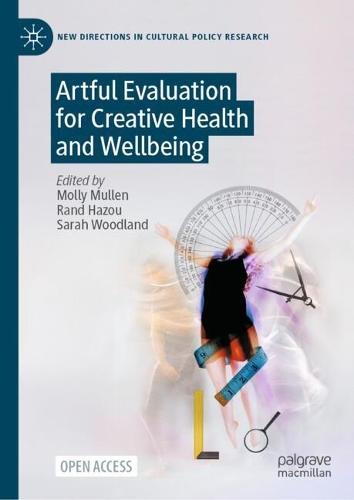
|
Overview
Full Product Details
Author: Molly Mullen , Rand Hazou , Sarah Woodland
Publisher: Springer Nature Switzerland AG
Imprint: Palgrave Macmillan
ISBN: 9783032170620
ISBN 10: 3032170621
Pages: 269
Publication Date: 03 May 2026
Audience:
Professional and scholarly
,
Professional & Vocational
Format: Hardback
Publisher's Status: Active
Availability: Not yet available 
This item is yet to be released. You can pre-order this item and we will dispatch it to you upon its release.
Table of Contents
.- 1. Introduction: Re-evaluating evaluation, Molly Mullen, Sarah Woodland, and Rand Hazou, Section 1: What is of value.- 2. What is of Value in the Learning Disabled Theatre of Different Light? Tony McCaffrey.- 3. Southside Stories: Pacific artists, funding, evaluation, and wellbeing in South Auckland, Michelle Johansson, Section 2: Justice-Oriented Evaluation.- 4. Queevaluing The Coming Back Out Ball: Towards a creative framework for self-determined values, Peta Murray, Marnie Badham, Tristan Meecham, and Bec Reid.-5. Home Ground: Evaluating the liminal space, Jacqui Moyes and Fran Kewene.- 6. Listening, Witnessing, and Creative Repair: Towards justice-oriented approaches to valuing lived experience expertise and trauma-informed co-creative practice, Poppy de Souza and Rebecca J Moran, Section 3: Community wellbeing, participation and self-determination.- 7. Experimenting with Life in Vacant Spaces: Reflections on assessing and communicating holistic wellbeing outcomes, Kelly Dombroski.- 8. Hobson Street Theatre Company: Developing an evaluation framework, Rand Hazou, Bronwyn Bent, Joeli Thacker, John Hughes, Richard Nightingale, Leonard Mathews, Kelly Tunui, and Gem McIver.- 9. Project X: Co-creating a meaningful evaluation framework for a creative youth wellbeing programme in Aotearoa, Amber Walls and Borni Te Rongopai Tukiwaho.- 10. Participatory Songwriting as Evaluative Research: Learning from adolescent experiences of voice and voicelessness, Gillian Howell, Section 4: Arts as evaluative practices.- 11Contested Zones: Circus science collaboration on issues of Australian ecologies, Linda Hassall and Natalie Lazaroo.- 12. Fleshy Socialities: Evaluative practices in theatre, performance, health, and wellbeing, Freebody, Mullen, Snider, and Sterback.- 13. Conclusion.
Reviews
Author Information
Molly Mullen works at Waipapa Taumata Rau/University of Auckland, New Zealand. With a professional background in children’s theatre, youth theatre, applied theatre, and arts education, her research focuses on the intersection of policy, funding, and practice in applied theatre and socially engaged arts. She has published extensively, including Applied Theatre: Economies (2018), and is the co-editor of Research in Drama Education: The Journal of Applied Theatre and Performance. Rand Hazou is a Palestinian theatre practitioner and scholar whose work explores arts engaging with rights and social justice. In 2004, he was commissioned by the UNDP to work in the Occupied Territories in Palestine as a theatre consultant running workshops for Palestinian youths. In Aotearoa, he has led teaching and creative projects with prison, aged-care, and street communities. From 2019 to 2024, he was a researcher on the Health Research Council-funded project Wellbeing and the Precariat, examining how experiences of poverty affect working families’ wellbeing. He is an Associate Professor at Massey University, Aotearoa, New Zealand. Sarah Woodland is a Senior Lecturer in theatre at the Victorian College of the Arts, University of Melbourne, Australia, where she teaches undergraduate and postgraduate theatre. Her research focuses on applied theatre, socially engaged and participatory arts, with particular attention to intercultural praxis for justice and wellbeing. She has published extensively on these topics and is a co-editor of Australasian Drama Studies.
Tab Content 6
Author Website:
Countries Available
All regions
|