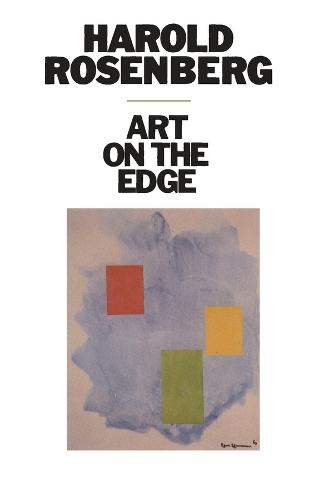
Overview
""As a stylist, in his descriptions of art and movements and books, Rosenberg has no equal. . . . One is grateful for [this] essay collection. To my mind, his piece on art criticism and the distinction between it and art history is alone worth the price of the book.""—Corinne Robins, New York Times Book Review
Full Product Details
Author: Harold Rosenberg
Publisher: The University of Chicago Press
Imprint: University of Chicago Press
Edition: New edition
Dimensions:
Width: 1.40cm
, Height: 0.20cm
, Length: 2.00cm
Weight: 0.369kg
ISBN: 9780226726748
ISBN 10: 0226726746
Pages: 318
Publication Date: 15 June 1983
Audience:
College/higher education
,
Professional and scholarly
,
Undergraduate
,
Postgraduate, Research & Scholarly
Format: Paperback
Publisher's Status: Active
Availability: Manufactured on demand

We will order this item for you from a manufactured on demand supplier.
Reviews
In this collection of essays Rosenberg, as always, meticulously attends to the integrity of the made-thing ; an equal attention to the reciprocity between artist and culture lends a fine moral quality to his aesthetic. The essays are divided into three sections: Creators, Reflections, consisting of a single and singular near-manifesto which outlines the obligations and uses of art criticism; and Situations. The edge of the title describes the boundary between fine and commercial, between the creator and the spectator, between, in effect, art as vital experience and art as artifact. In Rosenberg's view art, its makers, and its critics are caught up in a cultural-political morass that threatens to rob them of their urgency, of their real and potential value. His touchstones for redeeming cultural values are the first modernists - Duchamp, Miro, and their heirs - Warhol, Kelly, et al. - to name only a few to whom he devotes individual essays. The Duchamp piece, appropriately the first in the book, reassesses the artist who did the most to variously inspire and to corrupt his successors, to bemuse and enrage his public, and to blast through the boundaries whose current lack of definition leaves art on the edge. Rosenberg explodes the myth of Cultureburg; this collection shows a unique sensitivity to the profound and cogent issues attending fine art in this troubled era. (Kirkus Reviews)
Author Information
Harold Rosenberg (1906-1978) was one of the foremost New York intellectuals of the mid-twentieth century. He was an art critic for The New Yorker from 1962 until 1978. Rosenberg, together with Clement Greenberg, radically reshaped the interpretation of art in the post-World-War-II period by promoting and examining abstract expression. He was a professor in the Committee on Social Thought at the University of Chicago from 1966 until his death.