Overview
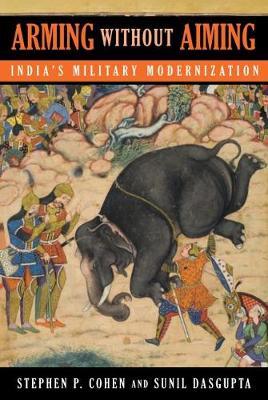
India’s explosive economic growth and rising affluence have led many experts to predict a major rearmament effort. The second-most populous nation in the world is beginning to wield the economic power one would expect of such a behemoth, while its border with Pakistan remains a potential tinderbox and the subcontinent remains vulnerable to religious extremism. So the resources for rearmament are there, as are the motives. But what in fact has India actually done in the way of improving its military? What should we expect to see in the future, and what will the likely results be? In Arming without Aiming, Stephen Cohen and Sunil Dasgupta answer those crucial questions.
Full Product Details
Author: Stephen P. Cohen ,
Sunil Dasgupta
Publisher: Bloomsbury Publishing Plc
Imprint: Brookings Institution
Dimensions:
Width: 15.20cm
, Height: 2.20cm
, Length: 22.90cm
Weight: 0.499kg
ISBN: 9780815704027
ISBN 10: 081570402
Pages: 350
Publication Date: 07 September 2010
Audience:
General/trade
,
General
Format: Hardback
Publisher's Status: Out of Print
Availability: In Print

Limited stock is available. It will be ordered for you and shipped pending supplier's limited stock.
Reviews
<p> The book is an empathetic, objective, and comprehensive narration and analysis of the evolution of Indian defense policy and management. The Indian strategic establishment is groping to find ways and means of safeguarding its progress toward becoming a twenty-first-century knowledge power in an international community still dominated by strategic thought from the World War II era. Steve Cohen and Sunil Dasgupta have brought into bold relief this somewhat inchoate and as yet not fully formulated effort. This will be a required reading for all senior service officers, civil servants, politicians, and academics engaged in Indian security. --K. Subrahmanyam, Indian defense expert
Much has been made of the emergence of India on the global stage. In Arming without Aiming, Cohen and Dasgupta provide an expert assessment of what India's rise means for its unevenly modernizing military, which is destined to become the third largest in the world. Anyone with an interest in the growing rivalry between India and China, or in the impact that a stronger, although still extraordinarily outdated, Indian military will mean for U.S.-India ties, should read this. This is an important book on an important subject, which is likely to remain unparalleled for many years. - Edward Luce, Washington bureau chief, Financial Times India's rise to power will remain incomplete until it acquires, and develops, the capacity to effectively utilize the full panoply of military power. Although India has made impressive strides in this direction in recent years, Stephen Cohen's and Sunil Dasgupta's Arming without Aiming demonstrates how much still needs to be done. This cautionary tale will be required reading for all those concerned about Indian defense policy and military modernization. - Ashley J. Tellis, Senior Associate, Carnegie Endowment for International Peace The book is an empathetic, objective, and comprehensive narration and analysis of the evolution of Indian defense policy and management. The Indian strategic establishment is groping to find ways and means of safeguarding its progress toward becoming a twenty-first-century knowledge power in an international community still dominated by strategic thought from the World War II era. Steve Cohen and Sunil Dasgupta have brought into bold relief this somewhat inchoate and as yet not fully formulated effort. This will be a required reading for all senior service officers, civil servants, politicians, and academics engaged in Indian security. - K. Subrahmanyam, Indian defense expert
Author Information
Stephen P. Cohen is a senior fellow in Foreign Policy Studies at the Brookings Institution. His is the author of numerous books, including The Idea of Pakistan and India: Emerging Power (both with Brookings).Sunil Dasgupta is director of the University of Maryland-Baltimore County's Political Science Program at the Universities at Shady Grove, and he is also a nonresident fellow in Foreign Policy Studies at Brookings. He also spent five years as senior correspondent for India Today.