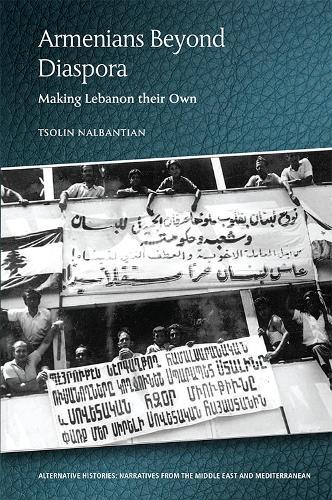
Overview
This book argues that Armenians around the world in the face of the Genocide, and despite the absence of an independent nation-state after World War I developed dynamic socio-political, cultural, ideological and ecclesiastical centres. And it focuses on one such centre, Beirut, in the postcolonial 1940s and 1950s. Tsolin Nalbantian explores Armenians' discursive re-positioning within the newly independent Lebanese nation-state; the political-cultural impact (in Lebanon as well as Syria) of the 19468 repatriation initiative to Soviet Armenia; the 1956 Catholicos election; and the 1957 Lebanese elections and 1958 mini-civil war. What emerges is a post-Genocide Armenian history of principally power, renewal and presence, rather than one of loss and absence.
Full Product Details
Author: Tsolin Nalbantian (Lecturer in Modern Middle East History, Leiden University)
Publisher: Edinburgh University Press
Imprint: Edinburgh University Press
Dimensions:
Width: 15.60cm
, Height: 1.30cm
, Length: 23.40cm
Weight: 0.340kg
ISBN: 9781474458573
ISBN 10: 1474458572
Pages: 240
Publication Date: 31 August 2021
Audience:
Professional and scholarly
,
Professional & Vocational
Format: Paperback
Publisher's Status: Active
Availability: Manufactured on demand

We will order this item for you from a manufactured on demand supplier.
Reviews
Armenians Beyond Diaspora is a major contribution to the field of Middle Eastern Studies. Nalbantian situates Armenians of Lebanon in the larger context of the Middle East during the Cold War period. Through her unique ability of analyzing the political discourse of the time, Nalbantian demonstrates how the bi-polar system had serious ramifications on Lebanon and its Armenian citizens. In this journey between time and space, the local and global, Nalbantian weaves together a narrative that combines history and anthropology in telling the story of a community which has been marginalized in the mainstream historiography of the Middle East in general and Lebanese historiography in particular.--Bedross Der Matossian, University of Nebraska-Lincoln Armenians Beyond Diaspora is an important contribution to both Armenian Studies and Lebanese historiography, and through it, Nalbantian offers an exciting new path for how minority communities, rather than serving as footnotes to national or regional histories, can be better understood as socially and politically integral parts of those same histories.--Sean Lee ""Mediterranean Politics"" What emerges (from this book) is a post-Genocide Armenian history of - principally - power, renewal and presence, rather than one of loss and absence.-- ""Armenian Voice"" While ""diaspora,"" as Khachig Tololyan has written, is useful to ""think with,"" what would it be to think without? Or, as Tsolin Nalbantian urges in her remarkable new book, to think beyond?--Sylvia Angelique Alajaji ""Journal of the Society for Armenian Studies""
"Armenians Beyond Diaspora is a major contribution to the field of Middle Eastern Studies. Nalbantian situates Armenians of Lebanon in the larger context of the Middle East during the Cold War period. Through her unique ability of analyzing the political discourse of the time, Nalbantian demonstrates how the bi-polar system had serious ramifications on Lebanon and its Armenian citizens. In this journey between time and space, the local and global, Nalbantian weaves together a narrative that combines history and anthropology in telling the story of a community which has been marginalized in the mainstream historiography of the Middle East in general and Lebanese historiography in particular.--Bedross Der Matossian, University of Nebraska-Lincoln Armenians Beyond Diaspora is an important contribution to both Armenian Studies and Lebanese historiography, and through it, Nalbantian offers an exciting new path for how minority communities, rather than serving as footnotes to national or regional histories, can be better understood as socially and politically integral parts of those same histories.--Sean Lee ""Mediterranean Politics"" What emerges (from this book) is a post-Genocide Armenian history of - principally - power, renewal and presence, rather than one of loss and absence.-- ""Armenian Voice"" While ""diaspora,"" as Khachig Tololyan has written, is useful to ""think with,"" what would it be to think without? Or, as Tsolin Nalbantian urges in her remarkable new book, to think beyond?--Sylvia Angelique Alajaji ""Journal of the Society for Armenian Studies"""
Author Information
Tsolin Nalbantian is Lecturer in Modern Middle East History at Leiden University. She is co-series editor of Critical, Connected Histories (Leiden University Press) and has published articles in Mashriq & Mahjar, MESA Review of Middle East Studies and History Compass. She has written the entry ‘Armenians in the Middle East’ for the Routledge Handbook of Minorities in the Middle East (2018).