Overview
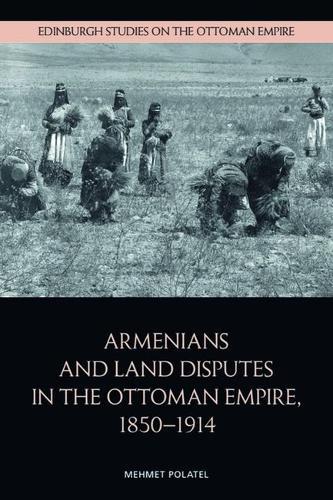
Armenians and Land Disputes in the Ottoman Empire traces the transformation of land disputes involving Armenians into the Armenian land question from the mid-nineteenth century to the outbreak of the First World War. Situating this event into its historical context marked by the rise of the central administrative state, encroachment of capitalism and the new territorial turn that changed the political significance of land ownership, this book argues that the Armenian land question was shaped by two conflicting trends: liberalisation and nationalisation of land. The book also shows how mass violence transformed competitive struggles and socioeconomic life and structures on the one hand, and how these struggles strained intercommunal relations and blocked possibilities of normalisation on the other. Examining the actions and discourses of Armenian and Kurdish intellectuals, Muslim powerholders in the provinces, and Ottoman officials and the Istanbul elite along with the institutions, local and national, that sustained these groups, it populates a large blank space in our existing picture of the late Ottoman Empire.
Full Product Details
Author: Mehmet Polatel (Research Coordinator of the Cultural Heritage Program, Hrant Dink Foundation, Istanbul)
Publisher: Edinburgh University Press
Imprint: Edinburgh University Press
ISBN: 9781399528603
ISBN 10: 1399528602
Pages: 312
Publication Date: 28 February 2025
Audience:
College/higher education
,
Postgraduate, Research & Scholarly
Format: Hardback
Publisher's Status: Active
Availability: Manufactured on demand

We will order this item for you from a manufactured on demand supplier.
Language: English
Reviews
This ground-breaking work analyses the genealogy of the Armenian land question from the second half of the 19th century to the eve of World War. Mehmet Polatel has made a monumental contribution from both empirical and theoretical perspectives to the study of the agrarian question in the Ottoman Empire and beyond.--Bedross Der Matossian, University of Nebraska-Lincoln With meticulous research, deep archival dives and acute theoretical insights, Mehmet Polatel restores the lost history of the dispossession of the lands of Ottoman Armenians through misuse of the law and deployment of violence. Polatel brilliantly tells the tragic tale of nation-formation as a process by an imperial government aided by local officials and ordinary people. With graphic examples, precision in his analysis and a deep humanistic sensibility, he reveals how ideology, greed and the search for security lead to horrific crimes against humanity.--Ronald Grigor Suny, University of Michigan
This groundbreaking work analyses the genealogy of the Armenian land question from the second half of the 19th century to the eve of World War. Mehmet Polatel has made a monumental contribution from both empirical and theoretical perspectives to the study of the agrarian question in the Ottoman Empire and beyond.--Bedross Der Matossian, University of Nebraska-Lincoln With meticulous research, deep archival dives and acute theoretical insights, Mehmet Polatel restores the lost history of the dispossession of the lands of Ottoman Armenians through misuse of the law and deployment of violence. Polatel brilliantly tells the tragic tale of nation-formation as a process by an imperial government aided by local officials and ordinary people. With graphic examples, precision in his analysis and a deep humanistic sensibility, he reveals how ideology, greed and the search for security lead to horrific crimes against humanity.--Ronald Grigor Suny, University of Michigan
This groundbreaking work analyses the genealogy of the Armenian land question from the second half of the 19th century to the eve of World War. Mehmet Polatel has made a monumental contribution from both empirical and theoretical perspectives to the study of the agrarian question in the Ottoman Empire and beyond.--Bedross Der Matossian, University of Nebraska-Lincoln
Author Information
Mehmet Polatel is the academy coordinator for the Minority Rights Academy Project at the Hrant Dink Foundation based in Istanbul. He received his Ph.D. degree from Bogazici University in Istanbul and he won the Distinguished Dissertation Award of the Society for Armenian Studies. Prior to receiving his Ph.D., he earned an MA in Comparative Studies in History and Society from Koç University, Istanbul. After receiving his Ph.D., he was awarded a postdoctoral fellowship in Armenian Studies from the University of Michigan, Ann Arbor and a junior postdoctoral fellowship from the USC Shoah Foundation Center for Advanced Genocide Research. His main research interests include state-society relations, minority rights, property politics, cultural heritage, Armenian Genocide, and dispossession of Armenians. He co-authored a book with Uğur Ü. Üngör entitled Confiscation and Destruction: Young Turk Seizure of Armenian Properties (Bloomsbury, 2011) and published several articles and book chapters on the massacres of 1894-7, land question, and the Armenian Genocide.