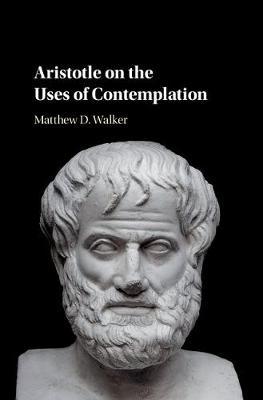
Full Product Details
Author: Matthew D. Walker
Publisher: Cambridge University Press
Imprint: Cambridge University Press
Dimensions:
Width: 15.60cm
, Height: 1.80cm
, Length: 23.50cm
Weight: 0.500kg
ISBN: 9781108421102
ISBN 10: 1108421105
Pages: 270
Publication Date: 31 May 2018
Audience:
Professional and scholarly
,
Professional & Vocational
Format: Hardback
Publisher's Status: Active
Availability: Manufactured on demand

We will order this item for you from a manufactured on demand supplier.
Reviews
'This is an important book. It represents a key challenge to the view that Aristotle's ethics can adequately be understood apart from its biological and wider metaphysical background. In particular, it challenges the widespread view - widespread at least in the Anglophone world - that Aristotle is not a theist, or (more modestly) that his theism does not significantly inform his ethical theory ... In this rigorous, highly detailed and elegantly written monograph, Matthew Walker demonstrates the untenability of this myth, while simultaneously demonstrating how Aristotle's theism is deeply implicated in his metaphysical biology.' Tom Angier, Notre Dame Philosophical Review '[Walker's] discussion of contemplation differs substantially from most approaches to the subject and thus represents a noteworthy contribution to the literature ... [T]hroughout the monograph he shows himself to be a careful reader of Aristotle and a philosophically nuanced writer. Most importantly, he has offered a novel way of considering the value and the role of contemplation in Aristotle, which will surely spur a new and productive discussion on the subject.' R. Kathleen Harbin, The Classical Review 'Walker illuminates tricky and neglected texts such as the Protrepticus, and draws surprising parallels to various Platonic dialogs. These parts of the book are intrinsically interesting, yet as they forward the book's main argument, they are also useful. This book is clear and straightforward enough to be painlessly perusable, yet deep enough to repay long study. It is both a quick read (as scholarly commentaries go), and a must-read' Howard J. Curzer, Polis, The Journal for Ancient Greek and Roman Political Thought 'This is an important book. It represents a key challenge to the view that Aristotle's ethics can adequately be understood apart from its biological and wider metaphysical background. In particular, it challenges the widespread view - widespread at least in the Anglophone world - that Aristotle is not a theist, or (more modestly) that his theism does not significantly inform his ethical theory ... In this rigorous, highly detailed and elegantly written monograph, Matthew Walker demonstrates the untenability of this myth, while simultaneously demonstrating how Aristotle's theism is deeply implicated in his metaphysical biology.' Tom Angier, Notre Dame Philosophical Review '[Walker's] discussion of contemplation differs substantially from most approaches to the subject and thus represents a noteworthy contribution to the literature ... [T]hroughout the monograph he shows himself to be a careful reader of Aristotle and a philosophically nuanced writer. Most importantly, he has offered a novel way of considering the value and the role of contemplation in Aristotle, which will surely spur a new and productive discussion on the subject.' R. Kathleen Harbin, The Classical Review 'Walker illuminates tricky and neglected texts such as the Protrepticus, and draws surprising parallels to various Platonic dialogs. These parts of the book are intrinsically interesting, yet as they forward the book's main argument, they are also useful. This book is clear and straightforward enough to be painlessly perusable, yet deep enough to repay long study. It is both a quick read (as scholarly commentaries go), and a must-read' Howard J. Curzer, Polis, The Journal for Ancient Greek and Roman Political Thought
'This is an important book. It represents a key challenge to the view that Aristotle's ethics can adequately be understood apart from its biological and wider metaphysical background. In particular, it challenges the widespread view - widespread at least in the Anglophone world - that Aristotle is not a theist, or (more modestly) that his theism does not significantly inform his ethical theory ... In this rigorous, highly detailed and elegantly written monograph, Matthew Walker demonstrates the untenability of this myth, while simultaneously demonstrating how Aristotle's theism is deeply implicated in his metaphysical biology.' Tom Angier, Notre Dame Philosophical Review
Author Information
Matthew D. Walker is Assistant Professor of Humanities (Philosophy) at Yale-NUS College. His work focuses on ancient Greek philosophy and cross-cultural ethical theory, and has been published in numerous leading journals.