Overview
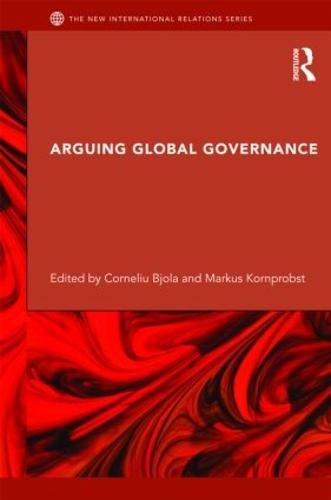
This book deals with the questions of how global governance can and ought to effectively address serious global problems, such as financial instability, military conflicts, distributive injustice and increasing concerns of ecological disasters. Providing a unified theoretical framework, the contributors to this volume utilise argumentation research, broadening the concept by identifying the concerns about agency, lifeworld and shared reasoning that different strands of argumentation research have in common. Furthermore, they develop the concept of argumentative deontology in order to make sense of the processes through which argumentation comes to shape global governance. Empirically, the book demonstrates how ideas define actors' interests, shape their interactions with each other, and ground intentions for collective action. Normatively, it provides an excellent theoretical platform for unveiling less visible manifestations of power in global politics and thereby improves our understandings of the ethical implications of global ordering. Addressing topical issues such as conflict and inter-civilizational dialogue, decision-making in international regimes and organizations, the World Social Forum, the Women's Environment and Development Organization and Tobin Tax, this book will be of interest to students and scholars of argumentation theory, globalization and global governance
Full Product Details
Author: Corneliu Bjola (University of Oxford, UK) ,
Markus Kornprobst (Diplomatic Academy of Vienna, Austria)
Publisher: Taylor & Francis Ltd
Imprint: Routledge
Weight: 0.750kg
ISBN: 9780415572170
ISBN 10: 0415572177
Pages: 320
Publication Date: 09 September 2010
Audience:
College/higher education
,
Tertiary & Higher Education
,
Undergraduate
Format: Hardback
Publisher's Status: Active
Availability: In Print

This item will be ordered in for you from one of our suppliers. Upon receipt, we will promptly dispatch it out to you. For in store availability, please contact us.
Reviews
'An important theoretical contribution to the literature on global governance, with apposite contemporary applications. The editors and contributors synthesise Searle's institutional philosophy with argumentation theory into a novel deontology to explain how the structure of global governance arrangements are in part constituted by processes of argumentation between actors. This is a major constructivist contribution to our understanding of the social mechanisms by which global governance mechanisms are constructed.' - Rodney Bruce Hall, University of Oxford, UK 'Though there is widespread agreement that many of the most pressing problems confronting the world require global solutions, there is far less agreement about the authority and ability of the agencies of global governance to provide them. The contributors to this innovative collection suggest that an answer lies in the power of argument to provide collectively binding common norms and goals that can transcend the myopia, self-interest and cultural misunderstandings that stand in the way of concerted action. A fruitful combination of theoretical and empirical enquiry, whereby a general framework is explored through a number of case studies, this collection offers a powerful and exemplary exploration of one of the most urgent challenges confronting international politics today.' - Richard Bellamy, University College London, UK
‘An important theoretical contribution to the literature on global governance, with apposite contemporary applications. The editors and contributors synthesise Searle's institutional philosophy with argumentation theory into a novel deontology to explain how the structure of global governance arrangements are in part constituted by processes of argumentation between actors. This is a major constructivist contribution to our understanding of the social mechanisms by which global governance mechanisms are constructed.’ - Rodney Bruce Hall, University of Oxford, UK ‘Though there is widespread agreement that many of the most pressing problems confronting the world require global solutions, there is far less agreement about the authority and ability of the agencies of global governance to provide them. The contributors to this innovative collection suggest that an answer lies in the power of argument to provide collectively binding common norms and goals that can transcend the myopia, self-interest and cultural misunderstandings that stand in the way of concerted action. A fruitful combination of theoretical and empirical enquiry, whereby a general framework is explored through a number of case studies, this collection offers a powerful and exemplary exploration of one of the most urgent challenges confronting international politics today.’ - Richard Bellamy, University College London, UK
An important theoretical contribution to the literature on global governance, with apposite contemporary applications. The editors and contributors synthesise Searle's institutional philosophy with argumentation theory into a novel deontology to explain how the structure of global governance arrangements are in part constituted by processes of argumentation between actors. This is a major constructivist contribution to our understanding of the social mechanisms by which global governance mechanisms are constructed. Rodney Bruce Hall, University of Oxford Though there is widespread agreement that many of the most pressing problems confronting the world require global solutions, there is far less agreement about the authority and ability of the agencies of global governance to provide them. The contributors to this innovative collection suggest that an answer lies in the power of argument to provide collectively binding common norms and goals that can transcend the myopia, self-interest and cultural misunderstandings that stand in the way of concerted action. A fruitful combination of theoretical and empirical enquiry, whereby a general framework is explored through a number of case studies, this collection offers a powerful and exemplary exploration of one of the most urgent challenges confronting international politics today. Richard Bellamy, University College London
Author Information
Markus Kornprobst is Chair of International Relations at the Vienna School of International Studies, Diplomatische Akademie Wien. Corneliu Bjola is University Lecturer and a Fellow of St. Cross College at the University of Oxford.