Overview
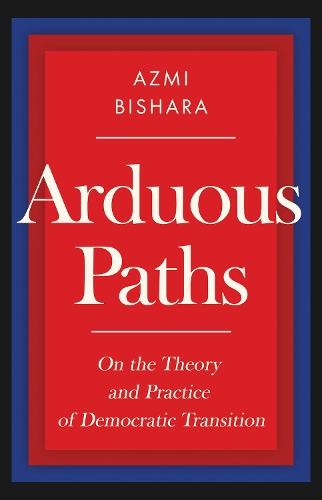
Azmi Bishara's Arduous Paths builds on his sizeable body of work on democracy through the lenses of civil society, state formation processes and theories, secularisation, populism and sectarianism. Arab transition scholarship has often been confined to theory, reliant on models born of specific historical conditions, and uncritical of concepts of democratisation. However, while situating his research within a critical theoretical framework, Bishara engages with the challenges facing wider global contemporary Arab societies by testing theory and lessons learned from democratic transitions elsewhere against Arab cases. This English translation of his book offers a detailed analysis and timely critique of modernisation and transition theory, interwoven with empirical evidence from the modern Middle East. Bishara evaluates the outcomes of transition experiences in Arab countries that have seen revolutions and popular uprisings, illustrating how-despite the centrality of the demand for democracy across the region during the 2010/2011 protests, and again in 2019-transition either failed or never took place. The book offers the reader a distinctly Arab contribution to the field of democratic transition studies, made all the more urgent given the relevance of the transition to democracy for those living under authoritarianism.'
Full Product Details
Author: Azmi Bishara
Publisher: C Hurst & Co Publishers Ltd
Imprint: C Hurst & Co Publishers Ltd
ISBN: 9781805263005
ISBN 10: 1805263005
Pages: 456
Publication Date: 19 March 2026
Audience:
Professional and scholarly
,
College/higher education
,
Professional & Vocational
,
Postgraduate, Research & Scholarly
Format: Hardback
Publisher's Status: Active
Availability: Not yet available

This item is yet to be released. You can pre-order this item and we will dispatch it to you upon its release.
Reviews
‘Building on Bishara’s previous works, this book crafts new coordinates for thinking about how the process of “reformist revolution” can successfully happen in the Arab-speaking regions. Drawing prudently on a wide range of literature, the treatment of the subject is compelling, cosmopolitan and timely.’ -- <b>John Keane, Professor of Politics, University of Sydney, and author of <i>Demagogues and Despots: Democracies on the Brink</i></b> ‘Producing a book on democratic transition in an era of precipitous democratic decline in the heartlands of “major democracies” is a challenging undertaking. But this insightful work takes this problem head on, shining a deeply critical, even iconoclastic, light on received thinking on democracy and democratisation. Foregrounding cases from the periphery, including the Middle East and Latin America, among others, it contextualises the debate within a bold rethinking of modernisation transition theories, taking the reader into very unfamiliar ground.’ -- <b>Abdelwahab El-Affendi, President and Provost, Doha Institute for Graduate Studies, and co-editor of <i>After the Arab Revolutions: Decentring Democratic Transition Theory</i></b> ‘A comprehensive survey of the literature on democratic transitions, assessing their value and applicability to the Arab world—particularly, but not exclusively, the 2011 uprisings and their aftermath. Bishara is one of the Arab world’s most prominent intellectuals, hence there exists a key audience of Arab readers who will read his work.’ -- <b>Marc Lynch, Professor of Political Science, George Washington University, and author of <i>America’s Middle East: The Ruination of a Region</i></b> ‘A fascinating analysis by a prominent Arab intellectual, offering his perspective on foundational democratisation theories and what the West can learn from the Arab world. It should garner interest among a wide readership and will be an important addition to the public debate.’ -- <b>Dana El-Kurd, Professor in the Department of Political Science, University of Richmond, and author of <i>Polarized and Demobilized: Legacies of Authoritarianism in Palestine</i></b>
Author Information
Azmi Bishara is one of the Arab world's most prominent scholars, a critic of authoritarianism and colonialism, and a staunch supporter of democratic transition in the region. He has published on political thought, state formation theory, social theory and philosophy. His books include Palestine: Matters of Truth and Justice; Sectarianism Without Sects and Arduous Paths: On the Theory and Practice of Democratic Transition (all published by Hurst); as well as Religion and Secularism in Historical Context; The Question of the State: Philosophy, Theory, and Context; and On Salafism.