|
|
|||
|
||||
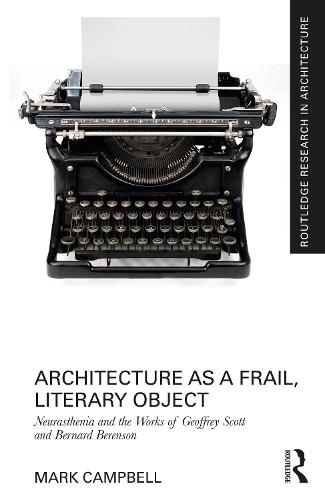
OverviewThis book considers the motives, ambitions, and malaprops of writing architectural history during the early-1900s – a moment that coincided with the emergence of modernity. In reference to a series of eccentric Anglo-American cultural figures, it considers the relationships between architecture, human perception, disease, and frailty to provide original ideas regarding the writing of architectural history and the literary construction of architecture. Architecture is not typically associated with frailty. Indeed, one of the founding principles of architecture is that it should aspire to be stable, resilient and indefatigable. In addition, architecture is also not typically thought of in terms of its literariness. Tracing this contradictoriness, this book considers architecture as a frail, literary object by examining the eccentric architectural criticism of Geoffrey Scott, author of The Architecture of Humanism (1914), together with the opportunistic connoisseurship of Bernard Berenson, the leading authority on the attribution of Italian Renaissance painting. Through a reading of their works, it interprets architecture as both “frail,” when viewed through the diffracted lens of nervous illness, and a form of “writing,” in which architecture assumes concrete form through literary description. This book will be of interest to academics, students, and researchers in architecture and architectural history. Full Product DetailsAuthor: Mark CampbellPublisher: Taylor & Francis Ltd Imprint: Routledge ISBN: 9781032381886ISBN 10: 1032381884 Pages: 226 Publication Date: 06 April 2026 Audience: College/higher education , Postgraduate, Research & Scholarly Format: Hardback Publisher's Status: Forthcoming Availability: Not yet available This item is yet to be released. You can pre-order this item and we will dispatch it to you upon its release. Table of ContentsReviewsAuthor InformationMark Campbell is the Reader in Architecture and Media at the Royal College of Art, UK. His research examines the histories and interrelationships between architecture, art, and media. Mark received his PhD and MA from Princeton University, USA, and his work has been supported by the Paul Mellon Centre for British Art, Barr Ferree Fund, Princeton University, Royal College of Art, and the Architectural Association. His books include Bernard Berenson: Connoisseurship and the Art Market (2026); The Parallax View (2024); and Paradise Lost (2016). Tab Content 6Author Website:Countries AvailableAll regions |
||||