Overview
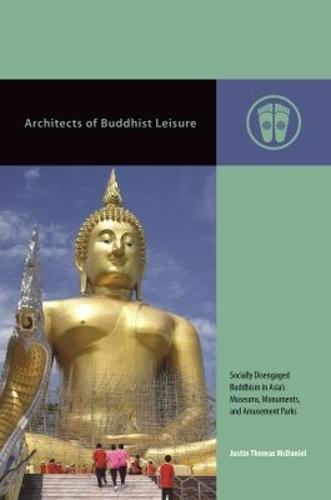
Buddhism, often described as an austere religion that condemns desire, promotes denial, and idealizes the contemplative life, actually has a thriving leisure culture in Asia. Creative religious improvisations designed by Buddhists have been produced both within and outside of monasteries across the region—in Nepal, Japan, Korea, Macau, Hong Kong, Singapore, Laos, Thailand, and Vietnam. Justin McDaniel looks at the growth of Asia’s culture of Buddhist leisure—what he calls “socially disengaged Buddhism”—through a study of architects responsible for monuments, museums, amusement parks, and other sites. In conversation with noted theorists of material and visual culture and anthropologists of art, McDaniel argues that such sites highlight the importance of public, leisure, and spectacle culture from a Buddhist perspective and illustrate how “secular” and “religious,” “public” and “private,” are in many ways false binaries. Moreover, places like Lek Wiriyaphan’s Sanctuary of Truth in Thailand, Su?i Tiên Amusement Park in Saigon, and Shi Fa Zhao’s multilevel museum/ritual space/tea house in Singapore reflect a growing Buddhist ecumenism built through repetitive affective encounters instead of didactic sermons and sectarian developments. They present different Buddhist traditions, images, and aesthetic expressions as united but not uniform, collected but not concise: Together they form a gathering, not a movement. Despite the ingenuity of lay and ordained visionaries like Wiriyaphan and Zhao and their colleagues Kenzo Tange, Chan-soo Park, Tadao Ando, and others discussed in this book, creators of Buddhist leisure sites often face problems along the way. Parks and museums are complex adaptive systems that are changed and influenced by budgets, available materials, local and global economic conditions, and visitors. Architects must often compromise and settle at local optima, and no matter what they intend, their buildings will develop lives of their own. Provocative and theoretically innovative, Architects of Buddhist Leisure asks readers to question the very category of “religious” architecture. It challenges current methodological approaches in religious studies and speaks to a broad audience interested in modern art, architecture, religion, anthropology, and material culture.
Full Product Details
Author: Justin Thomas McDaniel ,
Mark Michael Rowe
Publisher: University of Hawai'i Press
Imprint: University of Hawai'i Press
Dimensions:
Width: 14.90cm
, Height: 2.00cm
, Length: 22.60cm
Weight: 0.385kg
ISBN: 9780824876753
ISBN 10: 082487675
Pages: 282
Publication Date: 30 April 2018
Audience:
Professional and scholarly
,
Professional & Vocational
Format: Paperback
Publisher's Status: Active
Availability: In Print

This item will be ordered in for you from one of our suppliers. Upon receipt, we will promptly dispatch it out to you. For in store availability, please contact us.
Reviews
Justin McDaniel's new study is an excellent example of the extra-disciplinary methodologies architectural historians can draw on to better understand the diverse material and intellectual exchanges that have shaped the global built environment. . . . It is perhaps because Architects of Buddhist Leisure is not burdened by concerns of orthodoxy or aesthetic success that it allows readers to understand the category of Buddhist architecture as something more than a taxonomy of convenience. The book suggests a combinant set of research methodologies for assessing the ways architecture engages with diverse human experiences.-- Fabrications: The Journal of the Society of Architectural Historians, Australia and New Zealand
Author Information
Justin Thomas McDaniel is professor of Buddhist studies and chair of the Department of Religious Studies at the University of Pennsylvania. Mark Michael Rowe is associate professor in the Department of Religious Studies, McMaster University.