Overview
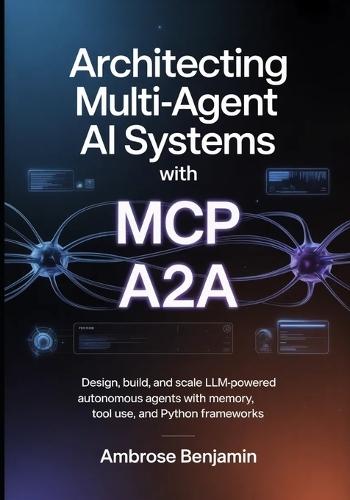
As large language models continue to evolve, the focus of modern AI development is shifting from single-model interactions to autonomous, goal-driven agentic systems. These systems are capable of reasoning, planning, executing tasks, and collaborating with other agents to solve complex problems. However, most existing tools abstract away critical details, leaving engineers without a clear understanding of how these systems are designed, orchestrated, and scaled in practice. This book provides a comprehensive, hands-on guide to engineering multi-agent AI systems from the ground up using Python. Rather than relying on opaque third-party frameworks, you will learn how to design and implement your own extensible agent architecture, giving you full control over behavior, communication, and system evolution. The journey begins with the fundamentals of agentic system design, including how large language models function as reasoning engines and how agents interact with tools, environments, and structured inputs. You will then progressively build a modular framework that supports tool invocation, structured data exchange, and stateful interactions. A central focus of the book is the integration of the Model Context Protocol (MCP) for managing context, memory, and long-term state. You will explore how to design agents that maintain awareness across interactions, enabling more adaptive and intelligent behavior. In parallel, the book introduces Agent-to-Agent (A2A) communication patterns, allowing multiple agents to collaborate through structured messaging, shared workflows, and coordinated task execution. As your system evolves, you will implement advanced capabilities such as secure tool usage, message routing, observability, and human-in-the-loop control mechanisms. The book also addresses practical concerns such as debugging complex agent interactions, managing system performance, and preparing your architecture for real-world deployment scenarios. Throughout the chapters, emphasis is placed on modularity, scalability, and maintainability, ensuring that the systems you build can grow beyond simple prototypes into production-ready solutions. Code examples are accompanied by detailed explanations, enabling you to understand not only how each component works, but how it fits into the broader system architecture. By the end of this book, you will have built a fully functional multi-agent framework capable of supporting complex workflows, integrating external tools, and adapting to dynamic environments. More importantly, you will gain a deep understanding of the design principles and engineering patterns required to create robust, extensible agentic AI systems. What You Will Learn How to design and implement LLM-powered agents from first principles How to build modular, extensible agent frameworks in Python How to integrate tool usage and structured input/output systems How to implement memory and context management using MCP How to design and orchestrate multi-agent systems using A2A communication How to build observable, debuggable, and production-ready architectures How to deploy and scale agent systems in real-world environments Architecting Multi-Agent AI Systems with MCP and A2A is a practical and technically grounded guide for engineers who want to move beyond black-box tools and gain full control over the design, implementation, and deployment of modern agentic AI systems.
Full Product Details
Author: Ambrose Benjamin
Publisher: Independently Published
Imprint: Independently Published
Dimensions:
Width: 17.80cm
, Height: 1.10cm
, Length: 25.40cm
Weight: 0.376kg
ISBN: 9798195238780
Pages: 212
Publication Date: 02 May 2026
Audience:
General/trade
,
General
Format: Paperback
Publisher's Status: Active
Availability: Available To Order

We have confirmation that this item is in stock with the supplier. It will be ordered in for you and dispatched immediately.