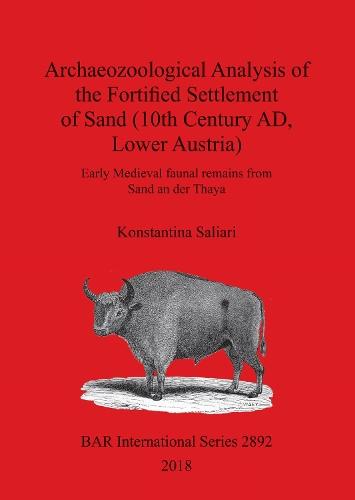
Archaeozoological Analysis of the Fortified Settlement of Sand (10th century AD, Lower Austria): Early Medieval faunal remains from Sand an der Thaya

Author:   Konstantina Saliari
Publisher:   BAR Publishing
ISBN:  

9781407316376


Pages:   175
Publication Date:   29 March 2018
Format:   Paperback
Availability:   Available To Order   Availability explained
We have confirmation that this item is in stock with the supplier. It will be ordered in for you and dispatched immediately.

Our Price $142.31 Quantity:  
Add to Cart

Share |

Archaeozoological Analysis of the Fortified Settlement of Sand (10th century AD, Lower Austria): Early Medieval faunal remains from Sand an der Thaya


Overview

This book presents an archaeozoological analysis of the Early Medieval fortified settlement Sand, in Lower Austria. The work describes the exceptional socio-economic organisation of a settlement based on its animal remains, at the border between Slavic and German spheres of influence. The investigation sheds light on aspects of daily life, the interaction between consumers and providers, and the exploitation of faunal resources. The first part of the book is dedicated to the environmental setting, the site, the material, and the methods applied. The main part presents a species by species analysis of the numerous faunal remains. The final part of the book discusses the archaeozoological results within the archaeological record, as well as the historical sources. The archaeozoological results show that the study of the faunal remains has played a decisive role in the archaeological interpretation of the site and substantially improved our understanding of historical processes and social dynamics.

Full Product Details

Author:   Konstantina Saliari
Publisher:   BAR Publishing
Imprint:   BAR Publishing
Weight:   0.698kg
ISBN:  

9781407316376


ISBN 10:   1407316370
Pages:   175
Publication Date:   29 March 2018
Audience:   Professional and scholarly ,  Professional & Vocational
Format:   Paperback
Publisher's Status:   Active
Availability:   Available To Order   Availability explained
We have confirmation that this item is in stock with the supplier. It will be ordered in for you and dispatched immediately.

Table of Contents

List of Figures List of Tables Abstract Chapter 1. Introduction Archaeozoology 1.2 The site of Sand and its archaeozoological context 1.3 Research questions and structure Chapter 2. Site and Material 2.1 Site 2.1.1 Location 2.1.2 Environmental setting 2.1.2.1 Geology 2.1.2.2 Present-day climatic conditions 2.1.2.3 Palaeo-climatic conditions - The Medieval Warm Period (MWP) 2.1.3 Archaeological research and interpretation 2.1.4 Archaeozoology of Sand: previous investigations and state of research 2.1.5 Historical context 2.1.6 Archaeological evidence for early medieval settlements in Lower Austria 2.1.7 Archaeological finds from the immediate region of Sand during the 9th and 10th centuries AD 2.2 Material 2.2.1 Quantification 2.2.2 Archaeological context Chapter 3. Methodology 3.1 Identification 3.2 Quantification 3.3 Skeletal element representation / body part representation 3.4 Sex ratio and age at death 3.4.1 Sex ratio 3.4.2 Age at death 3.5 Butchery marks 3.6 Morphometric analysis 3.7 Spatial analysis Chapter 4. Analysis by Species 4.1 Quantification and analysis of the archaeozoological material 4.1.1 Domesticated species 4.1.2 Wild species DOMESTICATED SPECIES 4.2 Cattle (Bos primigenius f. taurus) 4.2.1 Quantification 4.2.2 Sex ratio 4.2.2.1 Results 4.2.2.2 Interpretation 4.2.3 Age at death 4.2.3.1 Results 4.2.3.2 Interpretation 4.2.4 Combining sex and age distribution 4.2.4.1 Discussion and interpretation 4.2.5 Skeletal element distribution 4.2.5.1 Results and interpretation 4.2.6 Modifications 4.2.6.1 Butchery marks 4.2.7 Morphometric analysis 4.2.7.1 The comparative material 4.2.7.1.1 Dürrnberg 4.2.7.1.2 Nickelsdorf 4.2.7.1.3 Roseldorf 4.2.7.1.4 Bernhardsthal 4.2.7.1.5 Mikulcice 4.2.7.1.6 Gars-Thunau 4.2.7.1.7 Raabs 4.2.7.1.8 Stillfried 4.2.7.1.9 Sand 4.3 Sheep (Ovis orientalis f. aries) and Goat (Capra aegagrus f. hircus) 4.3.1 Quantification 4.3.2 Sex ratio 4.3.2.1 Results and interpretation 4.3.3 Age at death 4.3.3.1 Results and interpretation 4.3.4 Combining sex and age distribution 4.3.4.1 Discussion and interpretation 4.3.5 Skeletal element distribution 4.3.5.1 Results and interpretation 4.3.6. Modifications 4.3.6.1 Butchery marks 4.3.7 Morphometric analysis of goat 4.4 Pig (Sus scrofa f. domestica) 4.4.1 Quantification 4.4.2 Sex ratio 4.4.2.1 Results and interpretation 4.4.3 Age at death 4.4.3.1 Results and interpretation 4.4.4 Combining sex and age distribution 4.4.4.1 Discussion and interpretation 4.4.5 Skeletal element distribution 4.4.5.1 Results and interpretation 4.4.6 Modifications 4.4.6.1 Butchery marks 4.4.7 Size and shape 4.5 Horse (Equus ferus f. caballus) 4.6 Dog (Canis lupus f. familiaris) 4.7 Domestic fowl (Gallus gallus f. domestica) WILD SPECIES 4.8 Aurochs (Bos primigenius), Bison (Bison bonasus) and wild Bovidae 4.8.1 Identification 4.8.1.1 Previous research 4.8.1.2 Methodology 4.8.1.3 Results 4.8.2 Quantification 4.8.2.1 Aurochs 4.8.2.2 Bison 4.8.2.3 Unidentified fragments of wild Bovidae 4.8.3 Sex ratio 4.8.3.1 Results and interpretation for bison 4.8.4 Age at death 4.8.4.1 Results 4.8.5 Combining sex and age distribution 4.8.5.1 Discussion and interpretation 4.8.6 Skeletal element distribution and butchery marks 4.8.6.1 Results 4.9 Red deer (Cervus elaphus) 4.9.1 Quantification 4.9.2 Sex ratio and age at death 4.9.2.1 Results 4.9.3 Skeletal element distribution 4.9.3.1 Results 4.9.4 Morphometric analysis 4.9.4.1 Results 4.10 Roe deer and Elk (Capreolus capreolus and Alces alces) 4.10.1 Quantification 4.10.2 Sex ratio and age at death 4.10.2.1 Results 4.10.3 Skeletal element representation and butchery marks 4.10.3.1 Results 4.10.4 Morphometric analysis 4.10.4.1 Results 4.11 Wild boar (Sus scrofa) 4.11.1 Quantification 4.11.2 Sex ratio and age at death 4.11.2.1 Results 4.11.3 Skeletal element distribution 4.11.3.1 Results 4.11.4 Morphometric analysis 4.11.4.1 Results 4.12 European hare (Lepus europaeus) 4.13 Black rat (Rattus rattus) 4.14 Wild cat (Felis silvestris) 4.15 Carnivora, Lagomorpha, and Rodentia (fur animals) 4.16 Other wild species Chapter 5. Discussion 5.1 Environment 5.1.1 Wild species as environmental indicators and markers of human activities 5.2 Interpreting the faunal assemblages from Sand 5.2.1 Spatial analysis 5.2.1.1 Archaeological observations and animal bones from Sand 1 5.2.1.2 Archaeological observations and animal bones from Sand 2 5.2.1.3 Archaeological observations and animal bones from Westwall area 5.2.1.4 Summary 5.2.2 The socio-economic organisation of Sand 5.2.2.1 The role of the wild species in the economic organisation of Sand 5.2.2.2 Domesticated species as markers of provision - comparison with other representative sites 5.2.2.2.1 The system of provision and the economic organisation of Sand 5.3 Bridging archaeozoology and archaeology: unravelling the unique character of Sand 5.4 Historical test

Reviews

'This work exceeds by far the usual standard of archaeozoological analysis. It is really profound.' Dr Erich Pucher, Natural History Museum Vienna 'Could contribute greatly - it covers a little known area and time period, and very interesting faunal material.' Dr Gunther Karl Kunst, University of Vienna 'The author's new approach to the reconstruction of cattle breeds is pathbreaking for future research of this type. ... The results and the basic data provided are of eminent interest, especially for osteoarchaeologists working on medieval topics over the whole of Europe.' Dr Kerstin Pasda, Friedrich-Alexander-University of Erlangen-Nurnberg


'This work exceeds by far the usual standard of archaeozoological analysis. It is really profound.' Dr Erich Pucher, Natural History Museum Vienna 'Could contribute greatly - it covers a little known area and time period, and very interesting faunal material.' Dr Gunther Karl Kunst, University of Vienna 'The author's new approach to the reconstruction of cattle breeds is pathbreaking for future research of this type. ... The results and the basic data provided are of eminent interest, especially for osteoarchaeologists working on medieval topics over the whole of Europe.' Dr Kerstin Pasda, Friedrich-Alexander-University of Erlangen-Nurnberg


{\rtf1\fbidis\ansi\ansicpg1252\deff0\deflang2057{\fonttbl{\f0\fswiss\fprq2\fcharset0 Calibri;}{\f1\fnil\fcharset0 Verdana;}} \viewkind4\uc1\pard\ltrpar\lang1033\f0\fs22\lquote The zooarchaeological assemblage and its analysis are invaluable in discussion of the site and its residents: such close and \lquote uncontaminated\rquote evidence is, after all, very rare for an early medieval settlement. One interesting aspect to highlight is the detailed morphometric analysis of cattle populations which suggests that local rather than regional animal populations were exploited. Overall, Salieri here offers a strong and informative study of a fairly unique assemblage via a wide range of zooarchaeological methods, integrating historical sources where possible.\rquote Nora M Batterman, Medieval Archaeology, Volume 63 (2), 2019\par \lang2057\par \pard\ltrpar\sa160\sl252\slmult1\lquote This work exceeds by far the usual standard of archaeozoological analysis. It is really profound.\rquote Dr Erich Pucher, Natural History Museum Vienna\par \lquote Could contribute greatly - it covers a little known area and time period, and very interesting faunal material.\rquote Dr G\'fcnther Karl Kunst, University of Vienna\par \lquote\lang1031 The author\lang2057\rquote\lang1031 s new approach to the reconstruction of cattle breeds is pathbreaking for future research of this type. ... \lang2057 The results and the basic data provided are of eminent interest, especially for osteoarchaeologists working on medieval topics over the whole of Europe.\rquote \lang1031 Dr Kerstin Pasda, Friedrich-Alexander-University of Erlangen-N\'fcrnberg\lang2057\f1\fs17\par }


Author Information

Konstantina Saliari obtained her BA and MA in Archaeology at the University of Athens. She completed her PhD at the University of Vienna, focusing on archaeozoology, and she is now employed by the Museum of Natural History Vienna. She has participated in numerous archaeological excavations and scientific conferences.

Tab Content 6

Author Website:  

Countries Available

All regions
Latest Reading Guide

April RG 26_2


Shopping Cart
Your cart is empty
Shopping cart
Mailing List