Overview
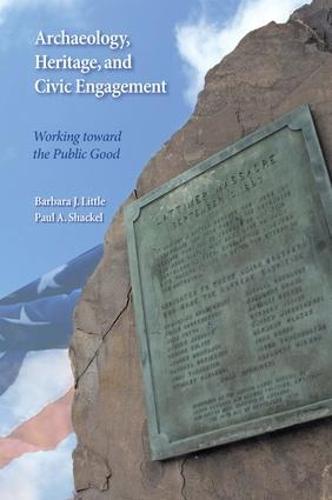
The definition of “public archaeology” has expanded in recent years to include archaeologists’ collaborations with and within communities and activities in support of education, civic renewal, peacebuilding, and social justice. Barbara Little and Paul Shackel, long-term leaders in the growth of a civically-engaged, relevant archaeology, outline a future trajectory for the field in this concise, thoughtful volume. Drawing from the archaeological study of race and labor, among other examples, the authors explore this crucial opportunity and responsibility, then point the way for the discipline to contribute to the contemporary public good.
Full Product Details
Author: Barbara J Little ,
Paul A Shackel
Publisher: Left Coast Press Inc
Imprint: Left Coast Press Inc
Dimensions:
Width: 15.20cm
, Height: 2.30cm
, Length: 22.90cm
Weight: 0.362kg
ISBN: 9781598746372
ISBN 10: 1598746375
Pages: 172
Publication Date: 28 February 2014
Audience:
College/higher education
,
Professional and scholarly
,
Postgraduate, Research & Scholarly
,
Professional & Vocational
Format: Hardback
Publisher's Status: Active
Availability: In Print

This item will be ordered in for you from one of our suppliers. Upon receipt, we will promptly dispatch it out to you. For in store availability, please contact us.
Reviews
This primer on transformation applies a range of civic engagement and community organizational research, practice, and exploration in an intentional reframing of issues, practices, and narratives of, at, and with heritage institutions, heritage properties, and heritage workers. Little and Shackel (both, Maryland), well-known to students and scholars of archaeology and heritage studies, advocate a reformation of the goals, processes, and outcomes of archaeological and other heritage work in order to connect narratives of the past with issues and debates in the present, the better to achieve social justice and lasting peace. ... In the view of the authors, heritage narratives can be deeply embedded and implicated in cultural and structural violence, making their interrogation a critical issue in the present. Summing Up: Recommended. CHOICE Magazine
This primer on transformation applies a range of civic engagement and community organizational research, practice, and exploration in an intentional reframing of issues, practices, and narratives of, at, and with heritage institutions, heritage properties, and heritage workers. Little and Shackel (both, Maryland), well-known to students and scholars of archaeology and heritage studies, advocate a reformation of the goals, processes, and outcomes of archaeological and other heritage work in order to connect narratives of the past with issues and debates in the present, the better to achieve social justice and lasting peace. ... In the view of the authors, heritage narratives can be deeply embedded and implicated in cultural and structural violence, making their interrogation a critical issue in the present. Summing Up: Recommended. --CHOICE Magazine
This primer on transformation applies a range of civic engagement and community organizational research, practice, and exploration in an intentional reframing of issues, practices, and narratives of, at, and with heritage institutions, heritage properties, and heritage workers. Little and Shackel (both, Maryland), well-known to students and scholars of archaeology and heritage studies, advocate a reformation of the goals, processes, and outcomes of archaeological and other heritage work in order to connect narratives of the past with issues and debates in the present, the better to achieve social justice and lasting peace. ... In the view of the authors, heritage narratives can be deeply embedded and implicated in cultural and structural violence, making their interrogation a critical issue in the present. Summing Up: Recommended. CHOICE Magazine
Author Information
Barbara J Little, Paul A. Shackel