Overview
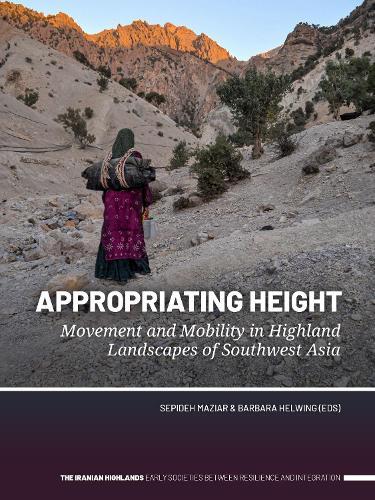
The essays in this book focus on archaeological approaches to the utilization of highland regions in southwestern and central Asia, examining the interplay between human communities and highland landscapes from the Paleolithic era to the present. Contributions combine case studies with theoretical considerations to explore adaptive strategies of movement. They discuss the significance of mobility within archaeological and anthropological discourse. Contributors engage with critical questions: How can archaeologists discern traces of movement and unravel material footprints of diverse mobility? How can they track shifts in mobility through time or regions? By systematizing observations on human spatial behavior across epochs and settings, these essays seek to test and refine traditional archaeological methodologies. They present nuanced frameworks and shed light on the adaptability and resilience of these communities. “Appropriating Height” aims to understand the human experience in highland environments. It is essential for those fascinated by the entanglement between people, place, and time, providing a comprehensive perspective on the legacy of human movement. This book is the second volume of a series published by the German-Iranian research cooperation “The Iranian Highlands: Resiliences and Integration in Premodern Societies”. The goal of the research project is to shine a new light on communities and societies that populated the Iranian highlands and their more or less successful strategies to cope with the many vagaries, the constant changes and risks of their natural and humanly shaped environments.
Full Product Details
Author: Sepideh Maziar ,
Barbara Helwing
Publisher: Sidestone Press
Imprint: Sidestone Press
ISBN: 9789464271096
ISBN 10: 9464271094
Pages: 180
Publication Date: 18 December 2024
Audience:
Professional and scholarly
,
Professional & Vocational
Format: Hardback
Publisher's Status: Active
Availability: Available To Order

We have confirmation that this item is in stock with the supplier. It will be ordered in for you and dispatched immediately.
Author Information
Sepideh Maziar is an associate researcher at the Goethe University of Frankfurt. She got her undergraduate degree in archaeology from the University of Tehran in Iran and achieved her Ph.D. in southwest Asian archaeology from Goethe university of Frankfurt, Germany. She directed archaeological fieldwork in Iran and Azerbaijan and is currently engaged in excavation the Prehistory site of Tappeh Balu in Iran and Kültepe II in Naxçivan. Her research interests include migration, social identity, collective memory, social networks, and resilience strategies in diasporic contexts, with a focus on prehistoric communities of southwest Asia. Barbara Helwing is an archaeologist holding a PhD in Prehistoric and Near Eastern Archaeology from the University of Heidelberg. After stations in Ankara, Berlin, Lyon and Sydney, she is currently the director of the Museum of the Ancient Near East SMB PK in Berlin, Germany, and honorary professor at the Freie Universität Berlin and the University of Sydney, Australia. She has directed archaeological fieldwork in Iran, Turkey, Azerbaijan, and Sri Lanka, and is currently engaged in excavating the late PPNB site Gürcü Tepe in Turkey. Among her significant publications are the edited volumes “Early Mining and Metallurgy on the western Central Iranian Plateau (2011, with A. Vatandoust and H. Parzinger) and “The Kura Projects” (2017, with T. Aliyev, B. Lyonnet, F. Guliyev, S. Hansen, and G. Mirtskhulava). Her research interests focus on the emergence of social inequality, and on the history of technology and innovations and their cultural impact, with a special perspective on the role of metallurgy therein.