Awards
- Commended for Hurston/Wright LEGACY Award (Nonfiction) 2004
Overview
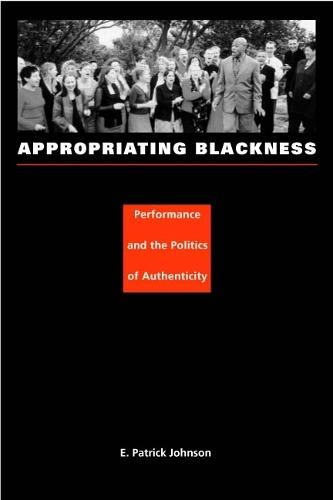
Considering how the politics of authentic identity are appropriated, Johnson looks at six specific sites of performed blackness: Marlon Riggs's influential documentary ""Black Is...Black Ain't""; nationalist writings by Amiri Baraka and Eldridge Cleaver and comedic routines by Eddie Murphy, David Alan Grier, and Damon Wayans; the vernacular of black gay culture; an oral history of a domestic worker in the South; gospel music as performed by a white Australian choir; and students in a performance studies classroom. By exploring the divergent aims and effects of these performances - which range from resisting racism, sexism, and homophobia to excluding sexual dissidents from the black community - Johnson deftly analyzes the multiple significations of blackness and their myriad political implications. His reflexive account considers his own complicity, as ethnographer and teacher, in authenticating narratives of blackness.
Full Product Details
Author: E. Patrick Johnson
Publisher: Duke University Press
Imprint: Duke University Press
Dimensions:
Width: 15.90cm
, Height: 2.50cm
, Length: 22.90cm
Weight: 0.644kg
ISBN: 9780822331544
ISBN 10: 0822331543
Pages: 384
Publication Date: 13 August 2003
Audience:
Professional and scholarly
,
Professional & Vocational
Format: Hardback
Publisher's Status: Active
Availability: In Print

This item will be ordered in for you from one of our suppliers. Upon receipt, we will promptly dispatch it out to you. For in store availability, please contact us.
Reviews
"""a welcome addition to the field."" The Lambda Book Report ""Johnson adds some heretofore unheard of twists to the continuing saga of this most important black intellectual thought... [A] welcome addition to the field.--Toni Lester, Lambda Book Report ""Johnson's first book ... is an accomplished and original study that deftly traverses both the mythology of, and networks of power that remain embedded within, America's deep racial segregation... [I]t is obvious that he seems destined to join Cornell West as a leading authority on race, not to mention performance studies and queer theory both in the United States and abroad.""-- James Tierney, M/C: A Journal of Media and Culture ""Appropriating Blackness marks a daring intervention in performance studies and African American studies. Its critical and ethical concerns will resonate for those working in numerous other fields, such as cultural anthropology; philosophy; critical ethnicity and race studies; gay, lesbian and queer studies; pedagogy studies; and music.""-- Antonio Viego, GLQ ""Appropriating Blackness offers an illuminating and compelling example of a critical politics of performing race. It decisively intervenes in disciplinary dialogues to rethink performance theory through the praxis of blackness, and to rethink black theory through performance... Appropriating Blackness is one of the most significant studies to emerge in performance studies. It is a book we will need, a book we will use, and a book that marks our best disciplinary work.""--Kristin M. Langellier, Text and Performance Quarterly"
""a welcome addition to the field."" The Lambda Book Report ""Johnson adds some heretofore unheard of twists to the continuing saga of this most important black intellectual thought... [A] welcome addition to the field.--Toni Lester, Lambda Book Report ""Johnson's first book ... is an accomplished and original study that deftly traverses both the mythology of, and networks of power that remain embedded within, America's deep racial segregation... [I]t is obvious that he seems destined to join Cornell West as a leading authority on race, not to mention performance studies and queer theory both in the United States and abroad.""-- James Tierney, M/C: A Journal of Media and Culture ""Appropriating Blackness marks a daring intervention in performance studies and African American studies. Its critical and ethical concerns will resonate for those working in numerous other fields, such as cultural anthropology; philosophy; critical ethnicity and race studies; gay, lesbian and queer studies; pedagogy studies; and music.""-- Antonio Viego, GLQ ""Appropriating Blackness offers an illuminating and compelling example of a critical politics of performing race. It decisively intervenes in disciplinary dialogues to rethink performance theory through the praxis of blackness, and to rethink black theory through performance... Appropriating Blackness is one of the most significant studies to emerge in performance studies. It is a book we will need, a book we will use, and a book that marks our best disciplinary work.""--Kristin M. Langellier, Text and Performance Quarterly
a welcome addition to the field. The Lambda Book Report Johnson adds some heretofore unheard of twists to the continuing saga of this most important black intellectual thought... [A] welcome addition to the field.--Toni Lester, Lambda Book Report Johnson's first book ... is an accomplished and original study that deftly traverses both the mythology of, and networks of power that remain embedded within, America's deep racial segregation... [I]t is obvious that he seems destined to join Cornell West as a leading authority on race, not to mention performance studies and queer theory both in the United States and abroad. -- James Tierney, M/C: A Journal of Media and Culture Appropriating Blackness marks a daring intervention in performance studies and African American studies. Its critical and ethical concerns will resonate for those working in numerous other fields, such as cultural anthropology; philosophy; critical ethnicity and race studies; gay, lesbian and queer studies; pedagogy studies; and music. -- Antonio Viego, GLQ Appropriating Blackness offers an illuminating and compelling example of a critical politics of performing race. It decisively intervenes in disciplinary dialogues to rethink performance theory through the praxis of blackness, and to rethink black theory through performance... Appropriating Blackness is one of the most significant studies to emerge in performance studies. It is a book we will need, a book we will use, and a book that marks our best disciplinary work. --Kristin M. Langellier, Text and Performance Quarterly
Author Information
E. Patrick Johnson is a performance artist and Assistant Professor of Performance Studies at Northwestern University.