Overview
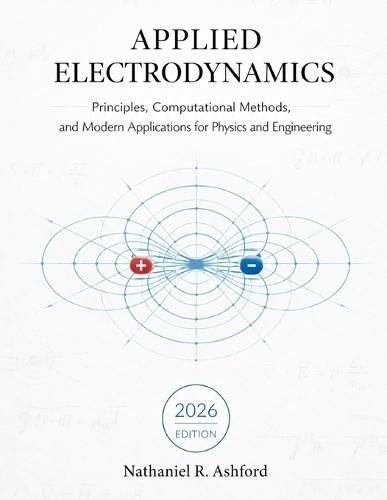
Somewhere between page one and the first impenetrable derivation, you realized there was a gap - a bridge that nobody built for you. This book is that bridge. Applied Electrodynamics picks up where introductory electromagnetic theory leaves off and carries you to the threshold of graduate-level physics. Every derivation is shown step by step - no skipped algebra, no ""it can be shown that,"" no leaps of faith. If you are working through electrodynamics on your own, without a professor to ask at office hours, this is the book that was written for you. WHAT MAKES THIS BOOK DIFFERENT Unlike any other electrodynamics textbook on the market, this book systematically integrates Python-based computational methods alongside analytical techniques in every chapter. You will not just derive electromagnetic fields on paper - you will simulate them, visualize them, and verify your analytical results computationally. Every problem in this book has a complete, worked solution in the back. Not just the final answer. The full derivation, every step, with explanations of the reasoning at each stage. For computational problems, the complete Python code and expected output are included. Modern applications appear in every chapter. You will see how electrostatic principles power capacitive touchscreens and MEMS devices, how electromagnetic wave theory enables fiber optic communications, how radiation theory connects to antenna design, and how metamaterials and photonic crystals are rewriting the rules of classical optics. This is not theory for its own sake - it is theory that builds technology. WHAT YOU WILL LEARN Chapter by chapter, you will build mastery from mathematical foundations through the full Maxwell equations, electromagnetic waves, radiation, special relativity, and computational electromagnetics. Key topics include: Green's functions for electrostatics - the single most important technique for bridging undergraduate to graduate electrodynamics, covered here at an introductory level that no other bridge text provides. Finite-difference time-domain (FDTD) simulation - you will build a working electromagnetic wave simulator from scratch in Python. The electromagnetic field tensor and covariant Maxwell equations - special relativity as the natural language of electrodynamics. Metamaterials, photonic crystals, and transformation optics - the frontiers where classical electromagnetic theory meets modern materials science. WHO THIS BOOK IS FOR This book serves advanced undergraduate physics students who want deeper mastery beyond their introductory course, self-learners working through electrodynamics independently, electrical engineering students seeking the physics-depth treatment their engineering texts do not provide, and graduate students preparing for Jackson-level coursework. Prerequisites: multivariable calculus, introductory electricity and magnetism, and basic Python familiarity. Chapter 1 provides a focused review of the mathematical tools you will need. If you have ever felt lost between the undergraduate and graduate levels of electromagnetic theory - if you wanted solutions you could check, computations you could run, and applications you could see - this book was written for exactly that moment.
Full Product Details
Author: Nathaniel R Ashford
Publisher: Independently Published
Imprint: Independently Published
Dimensions:
Width: 21.60cm
, Height: 2.00cm
, Length: 27.90cm
Weight: 0.875kg
ISBN: 9798195474706
Pages: 378
Publication Date: 04 May 2026
Audience:
General/trade
,
General
Format: Paperback
Publisher's Status: Active
Availability: Available To Order

We have confirmation that this item is in stock with the supplier. It will be ordered in for you and dispatched immediately.