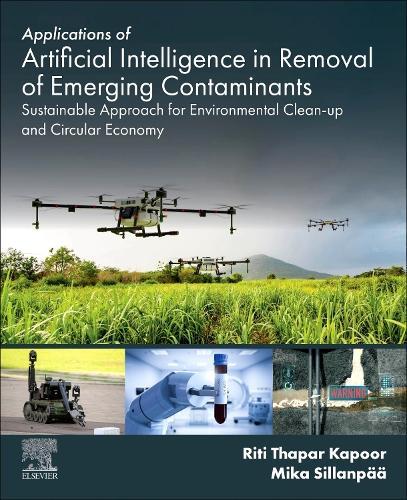
Applications of Artificial Intelligence in Removal of Emerging Contaminants: Sustainable Approach for Environmental Clean-up and Circular Economy

Author:   Mika Sillanpää (Professor, University of Johannesburg, South Africa) ,  Riti Thapar Kapoor (Centre for Plant and Environmental Biotechnology, Amity Institute of Biotechnology, Amity University Uttar Pradesh, Noida, Uttar Pradesh, India)
Publisher:   Elsevier - Health Sciences Division
ISBN:  

9780443267796


Pages:   382
Publication Date:   05 December 2025
Format:   Paperback
Availability:   Manufactured on demand   Availability explained
We will order this item for you from a manufactured on demand supplier.

Our Price $396.00 Quantity:  
Add to Cart

Share |

Applications of Artificial Intelligence in Removal of Emerging Contaminants: Sustainable Approach for Environmental Clean-up and Circular Economy


Overview

Full Product Details

Author:   Mika Sillanpää (Professor, University of Johannesburg, South Africa) ,  Riti Thapar Kapoor (Centre for Plant and Environmental Biotechnology, Amity Institute of Biotechnology, Amity University Uttar Pradesh, Noida, Uttar Pradesh, India)
Publisher:   Elsevier - Health Sciences Division
Imprint:   Elsevier - Health Sciences Division
Weight:   0.450kg
ISBN:  

9780443267796


ISBN 10:   0443267790
Pages:   382
Publication Date:   05 December 2025
Audience:   Professional and scholarly ,  College/higher education ,  Professional & Vocational ,  Postgraduate, Research & Scholarly
Format:   Paperback
Publisher's Status:   Active
Availability:   Manufactured on demand   Availability explained
We will order this item for you from a manufactured on demand supplier.

Table of Contents

1. Artificial intelligence: Introduction of technology, tools and need and significance for environmental sustainability 2. Artificial intelligence: historical background, types of tool and application for sustainable future 3. Artificial intelligence in pollution control and management: status and future prospects 4. Recent advances in use of artificial intelligence for optimization and automation of adsorption processes for wastewater treatment 5. Artificial intelligence and machine learning-based monitoring and design of biological wastewater treatment system 6. Applications of artificial intelligence tools for the adsorption of dyes from industrial effluent 7. Application of AI tools and smart technology in adsorption of heavy metals by using biochar 8. Current applications and future impacts of artificial intelligence and machine learning tools in removal of emerging contaminants 9. Applications of AI for the adsorption of pharmaceutical compounds from wastewater 10. Use of AI tools for the adsorption of organic pollutants from wastewater 11. Use of machine learning methods for dye adsorption prediction onto agricultural waste /biochar/ activated carbon 12. Comparison between conventional methods and artificial intelligence tools for wastewater treatment 13. Artificial neural networks (ANN) for the prediction of biochar yield and its application in bioremediation 14. Application of different AI models like fuzzy logic, genetic programming, model tree for prediction and removal of contaminants from wastewater treatment plants 15. Challenges with artificial intelligence and machine learning methods for implementation in water treatment and monitoring 16. Artificial intelligence technologies for forecasting air pollution and human health 17. Applications of artificial intelligence-based modeling for bioenergy system 18. Use of artificial intelligence tools in agro-waste management 19. Application of artificial intelligence and machine learning technologies for development of circular economy 20. Artificial intelligence: economical approaches for waste management and disposal 21. Artificial intelligence and machine learning tools: Patents and technologies transferred to the industries 22. Case studies from developed and developing nations: economic evaluation of contaminants removal/ waste recycling by AI tools 23. Case study on the use of artificial intelligence tools to reduce pesticides/synthetic fertilizers application in agricultural fields 24. Role of AI tools in a future bioeconomy for environmental clean-up: regulations and policy framework

Reviews

Author Information

Mika Sillanpää’s research work centers on chemical treatment in environmental engineering and environmental monitoring and analysis. The recent research focus has been on the resource recovery from waste streams. Sillanpää received his M.Sc. (Eng.) and D.Sc. (Eng.) degrees from the Aalto University where he also completed an MBA degree in 2013. Since 2000, he has been a full professor/adjunct professor at the University of Oulu, the University of Eastern Finland, the LUT University, the University of Eastern Finland and the University of Johannesburg. Dr. Riti Thapar Kapoor is Associate Professor in Amity Institute of Biotechnology, Amity University Uttar Pradesh, Noida, India. Dr. Kapoor received her Ph.D from University of Allahabad and worked as post - doctoral fellow at Banaras Hindu University, Varanasi, India. Dr. Kapoor has fourteen years of teaching and research experience and her area of specialization is environmental biotechnology, bioremediation, wastewater treatment and abiotic stresses. Dr. Kapoor has published 11 books and over 105 research papers in various journals of national and international repute. Dr. Kapoor has visited 8 countries for participation in different academic programmes. Dr. Kapoor has received prestigious travel award from Bill & Melinda Gates Research Foundation under CGIAR project for participation in International training programme held at International Rice Research Institute (IRRI), Manila, Philippines in 2010. She is also recipient of DST travel grant for participation in International Conference held at Sri Lanka in 2013. Dr. Kapoor has been awarded with Teacher’s Research Fellowship from Indian Academy of Sciences, Bengaluru in 2019. She has supervised and mentored a number of research projects sanctioned by different government funding agencies such as DAE, DST and UPCST etc. She has successfully supervised three research students for Ph.D. degree besides several (more than 80) masters and graduate students for their dissertation thesis.

Tab Content 6

Author Website:  

Countries Available

All regions
Latest Reading Guide

NOV RG 20252


Shopping Cart
Your cart is empty
Shopping cart
Mailing List