Overview
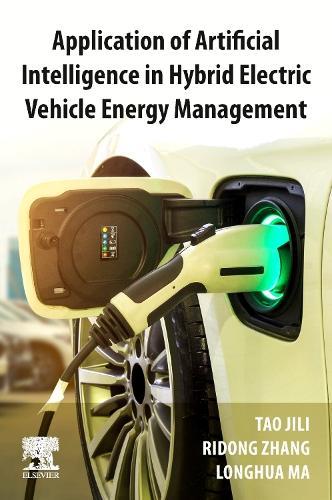
Application of Artificial Intelligence in Hybrid Electric Vehicle Energy Management
Full Product Details
Author: Tao Jili, Ph.D. (Institute of Ningbo Technology, Zhejiang University, Hangzhou, China) ,
Ridong Zhang, Ph.D. degree in control science and engineering from Zhejiang University. (Institute of Information and Control, Hangzhou Dianzi University, China) ,
Longhua Ma, Ph.D. degree in control science and engineering from Zhejiang University. (Zhejiang University, Hangzhou, China)
Publisher: Elsevier - Health Sciences Division
Imprint: Elsevier - Health Sciences Division
Weight: 0.550kg
ISBN: 9780443131899
ISBN 10: 0443131899
Pages: 346
Publication Date: 03 May 2024
Audience:
Professional and scholarly
,
Professional & Vocational
Format: Paperback
Publisher's Status: Active
Availability: Manufactured on demand

We will order this item for you from a manufactured on demand supplier.
Author Information
Tao Jili received the B.Sc. and M.Sc. degrees from Central South University, Changsha, China, in 2001 and 2004, respectively, and the Ph.D. degree from Zhejiang University, Hangzhou, China, in 2007. She is currently an Associate Professor with the Institute of Ningbo Technology, Zhejiang University, Ningbo, China. Her current research interests include intelligent optimization, modeling, and its applications to electronic system design and control system design for HEV, chemical processes. Ridong Zhang received the Ph.D. degree in control science and engineering from Zhejiang University, Hangzhou, China, in 2007. From 2012 to 2016, he was a Visiting Professor with the Chemical and Biomolecular Engineering Department, The Hong Kong University of Science and Technology, Hong Kong. He is currently a Professor with the Institute of Information and Control, Hangzhou Dianzi University, Hangzhou. His current research interests include modeling and control for chemical nonlinear systems and HEV. Longhua Ma received the B.S. degree in industrial electrical automation from Lanzhou Jiaotong University,Lanzhou, China, in 1986, the M.S. degree and Ph.D. degree in control science and engineering from Zhejiang University, Hangzhou, China, in 1993 and 2002, respectively. He was an associate research fellow with National engineering research center for industrial automation, Zhejiang University, Hangzhou, China from 1993 to 2008.From 2008 to 2012, he was an associate professor with School of aeronautics and astronautics, Zhejiang University, Hangzhou, China. Currently, he is a professor with Ningbo Industrial Internet Institute, Ningbo, China. He has (co)author four books and published over 70 international journal and conference papers. His currently research interests include network security, new energy and electric vehicle energy management and control and inertial navigation theory and application.