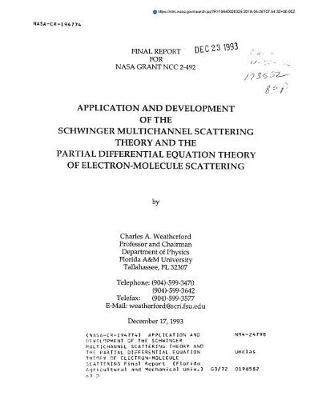
Application and Development of the Schwinger Multichannel Scattering Theory and the Partial Differential Equation Theory of Electron-Molecule Scattering

Author:   National Aeronaut Administration (Nasa)
Publisher:   Createspace Independent Publishing Platform
ISBN:  

9781722240417


Pages:   82
Publication Date:   06 July 2018
Format:   Paperback
Availability:   Available To Order   Availability explained
We have confirmation that this item is in stock with the supplier. It will be ordered in for you and dispatched immediately.

Our Price $65.97 Quantity:  
Add to Cart

Share |

Application and Development of the Schwinger Multichannel Scattering Theory and the Partial Differential Equation Theory of Electron-Molecule Scattering


Overview

One version of the multichannel theory for electron-target scattering based on the Schwinger variational principle, the SMC method, requires the introduction of a projection parameter. The role of the projection parameter a is investigated and it is shown that the principal-value operator in the SMC equation is Hermitian regardless of the value of a as long as it is real and nonzero. In a basis that is properly orthonormalizable, the matrix representation of this operator is also Hermitian. The use of such basis is consistent with the Schwinger variational principle because the Lippmann-Schwinger equation automatically builds in the correct boundary conditions. Otherwise, an auxiliary condition needs to be introduced, and Takatsuka and McKoy's original value of a is one of the three possible ways to achieve Hermiticity. In all cases but one, a can be uncoupled from the Hermiticity condition and becomes a free parameter. An equation for a based on the variational stability of the scattering amplitude is derived; its solution has an interesting property that the scattering amplitude from a converged SMC calculation is independent of the choice of a even though the SMC operator itself is a-dependent. This property provides a sensitive test of the convergence of the calculation. For a static-exchange calculation, the convergence requirement only depends on the completeness of the one-electron basis, but for a general multichannel case, the a-invariance in the scattering amplitude requires both the one-electron basis and the N plus 1-electron basis to be complete. The role of a in the SMC equation and the convergence property are illustrated using two examples: e-CO elastic scattering in the static-exchange approximation, and a two-state treatment of the e-H2 Chi(sup 1)Sigma(sub g)(+) yields b(sup 3)Sigma(sub u)(+) excitation. Weatherford, Charles A. Unspecified Center...

Full Product Details

Author:   National Aeronaut Administration (Nasa)
Publisher:   Createspace Independent Publishing Platform
Imprint:   Createspace Independent Publishing Platform
Dimensions:   Width: 21.60cm , Height: 0.40cm , Length: 27.90cm
Weight:   0.213kg
ISBN:  

9781722240417


ISBN 10:   1722240415
Pages:   82
Publication Date:   06 July 2018
Audience:   General/trade ,  General
Format:   Paperback
Publisher's Status:   Active
Availability:   Available To Order   Availability explained
We have confirmation that this item is in stock with the supplier. It will be ordered in for you and dispatched immediately.

Table of Contents

Reviews

Author Information

Tab Content 6

Author Website:  

Countries Available

All regions
Latest Reading Guide

April RG 26_2


Shopping Cart
Your cart is empty
Shopping cart
Mailing List