Full Product Details
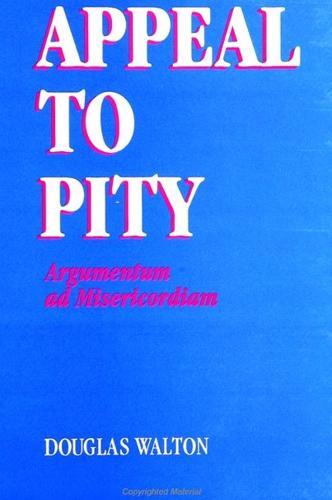
Author: Douglas Walton
Publisher: State University of New York Press
Imprint: State University of New York Press
Dimensions:
Width: 15.20cm
, Height: 2.50cm
, Length: 22.90cm
Weight: 0.340kg
ISBN: 9780791434628
ISBN 10: 0791434621
Pages: 225
Publication Date: 08 May 1997
Audience:
Professional and scholarly
,
Professional and scholarly
,
Professional & Vocational
,
Postgraduate, Research & Scholarly
Format: Paperback
Publisher's Status: Active
Availability: Out of stock

The supplier is temporarily out of stock of this item. It will be ordered for you on backorder and shipped when it becomes available.
Reviews
""Careful analyses are given of empathy, compassion, sympathy, and pity, and the differences between these. These analyses are useful for understanding the emotions, quite apart from an investigation of features of arguments. The analyses make it possible to distinguish arguments which contain an appeal to compassion from those containing an appeal to sympathy, and to further distinguish both of these appeals from the appeal to pity. Walton's discussion provides a sensitive and profound evaluation of arguments which occur frequently in daily life, but which are given only a superficial treatment in most texts."" - John Kearns, State University of New York at Buffalo
"""Careful analyses are given of empathy, compassion, sympathy, and pity, and the differences between these. These analyses are useful for understanding the emotions, quite apart from an investigation of features of arguments. The analyses make it possible to distinguish arguments which contain an appeal to compassion from those containing an appeal to sympathy, and to further distinguish both of these appeals from the appeal to pity. Walton's discussion provides a sensitive and profound evaluation of arguments which occur frequently in daily life, but which are given only a superficial treatment in most texts."" - John Kearns, State University of New York at Buffalo"
Careful analyses are given of empathy, compassion, sympathy, and pity, and the differences between these. These analyses are useful for understanding the emotions, quite apart from an investigation of features of arguments. The analyses make it possible to distinguish arguments which contain an appeal to compassion from those containing an appeal to sympathy, and to further distinguish both of these appeals from the appeal to pity. Walton's discussion provides a sensitive and profound evaluation of arguments which occur frequently in daily life, but which are given only a superficial treatment in most texts. - John Kearns, State University of New York at Buffalo
Author Information
Douglas Walton is Professor of Philosophy at the University of Winnipeg, Canada. He is the author of numerous books, including Plausible Argument in Everyday Conversation and Commitment in Dialogue: Basic Concepts of Interpersonal Reasoning, both published by SUNY Press, as well as Arguments from Ignorance; Argumentation Schemes for Presumptive Reasoning; A Pragmatic Theory of Fallacy; The Pace of Emotion in Argument; Slippery Slope Arguments; Begging the Question: Circular Reasoning as a Tactic of Argumentation; Practical Reasoning: Goal-Driven, Knowledge-Based, Action-Guiding Argumentation; and Informal Logic: A Handbook for Critical Argumentation.