Overview
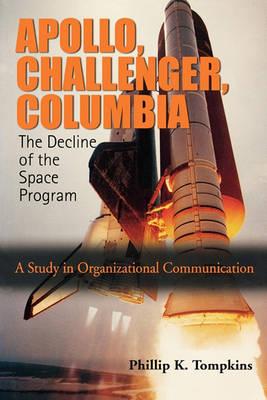
Apollo, Challenger, Columbia: The Decline of the Space Program provides unparalleled longitudinal insight into the organizational successes and failures of NASA. The book treats NASA over its 45-year history from 1958 to 2003, concentrating on five ""data points"" * 1967: when Tompkins first served as a Summer Faculty Consultant in Organizational Communication to legendary rocket scientist Wernher von Braun during the Apollo Program. * 1968: when he served in the same capacity to help reorganize NASA's Marshall Space Flight Center. * 1986: when he investigated the communication failures that caused the explosion of the space shuttle Challenger. * 1987: when he researched NASA's highly successful Aviation Safety Reporting System. * 2003: when he interpreted the communication failures leading up to the catastrophic failure of the space shuttle Columbia. The result is a presentation of concrete communication correlates of organizational success and failure. Tompkins is a master of what Clifford Geertz called ""thick description."" The result is a compelling, richly detailed, longitudinal case study concentrating on processual changes in communication-as-organization. In this book, Tompkins introduces theory subtly, inserting it to explain details of the organization that would otherwise defy understanding. In considering other organizations in trouble, Tompkins identifies ten ""communication transgressions,"" one of which, for example, is ""ignorantia affectata""--an affected or cultivated ignorance of organizational problems. In contrast to these failed organizations and their pathologies, Tompkins offers a sketch of two healthy organizations that live by ""value logics""--applying ethical values in the organizational workplace. There are lessons to be learned from NASA's disasters. With all of the high-profile ethical lapses in U.S. corporations, Tompkins advocates individuals and organizations taking responsibility for their actions.
Full Product Details
Author: Phillip K Tompkins (University of Colorado at Boulder (Emeritus)) ,
Emily V Tompkins
Publisher: Oxford University Press
Imprint: Oxford University Press
Dimensions:
Width: 15.00cm
, Height: 2.00cm
, Length: 22.60cm
Weight: 0.454kg
ISBN: 9780195330441
ISBN 10: 0195330447
Pages: 288
Publication Date: 23 July 2004
Audience:
General/trade
,
General
Format: Paperback
Publisher's Status: Active
Availability: Awaiting stock

The supplier is currently out of stock of this item. It will be ordered for you and placed on backorder. Once it does come back in stock, we will ship it out for you.
Reviews
This book deviates from traditional organization communication texts because it is a detailed case study of one particular organization (yet is tied to other organizations). Tompkins helps to show how communication theory concepts have real-world significance.... [He does] a great job of introducing key communication concepts and applying them to the history of the space program. I love the author's writing style--it is a captivating story and provides strong academic insight. I think students will love this book.... --John Oetzel, University of New Mexico<br> While the unfolding of the sequence of events nicely frames the book, Tompkins brings in relevant theories and concepts that provide the needed foundations for understanding practice. The book provides many teaching moments about organizational communication, including such topics as culture, decision-making, identification, leadership, change, structure, and ethics. Few books in our field do this good a job of telling a compelling story while also providing valuable theoretical insight. --Greg Larson, University of Montana<br>
"""This book deviates from traditional organization communication texts because it is a detailed case study of one particular organization (yet is tied to other organizations). Tompkins helps to show how communication theory concepts have real-world significance.... [He does] a great job of introducing key communication concepts and applying them to the history of the space program. I love the author's writing style--it is a captivating story and provides strong academic insight. I think students will love this book....""--John Oetzel, University of New Mexico ""While the unfolding of the sequence of events nicely frames the book, Tompkins brings in relevant theories and concepts that provide the needed foundations for understanding practice. The book provides many teaching moments about organizational communication, including such topics as culture, decision-making, identification, leadership, change, structure, and ethics. Few books in our field do this good a job of telling a compelling story while also providing valuable theoretical insight.""--Greg Larson, University of Montana"