Overview
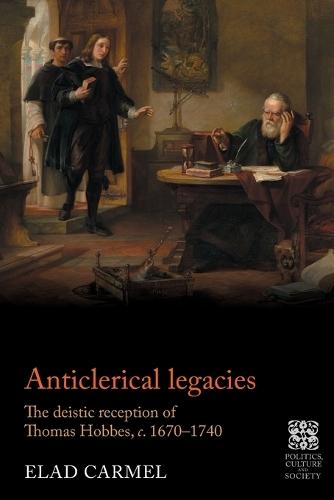
Anticlerical legacies is the first comprehensive study of the reception of Thomas Hobbes's ideas by the English deists and freethinkers in the seventeenth and eighteenth centuries. One of the most important English philosophers of all time, Hobbes's theories have had an enduring impact on modern political and religious thought. This book offers a new perspective on the afterlife of Hobbes's philosophy, focusing on the readers who were most sympathetic to his critical and radical ideas in the decades following his death. It investigates how Hobbes's ideas shaped the English anticlerical campaign that peaked in the early eighteenth century and that was essential for the emergence of the early Enlightenment. The book shows that a large number of writers Charles Blount, John Toland, Anthony Collins, Matthew Tindal, Thomas Morgan, and many others were more Hobbesian than has ever been appreciated. Not only did they engage consistently with Hobbes's ideas, they even invoked his authority at a time when doing so was highly unpopular. Most fundamentally, they carried on Hobbes's war against the kingdom of darkness and used various Hobbesian weapons for their own war against priestcraft. Analysing the ways in which the deists and freethinkers developed their nuanced theories and conducted their heated dialogues with the orthodoxy, they emerge from this study as sophisticated and valuable theorists in their own right. The case of Hobbes and his successors demonstrates that anticlericalism was a key component of a much larger programme whose primary aim was to secure civil harmony, peace, and stability.
Full Product Details
Author: Elad Carmel
Publisher: Manchester University Press
Imprint: Manchester University Press
Dimensions:
Width: 15.60cm
, Height: 31.90cm
, Length: 23.40cm
Weight: 0.012kg
ISBN: 9781526195821
ISBN 10: 1526195828
Pages: 248
Publication Date: 20 January 2026
Audience:
College/higher education
,
Professional and scholarly
,
General/trade
,
Tertiary & Higher Education
,
Professional & Vocational
Format: Paperback
Publisher's Status: Forthcoming
Availability: Not yet available, will be POD

This item is yet to be released. You can pre-order this item and we will dispatch it to you upon it's release. This is a print on demand item which is still yet to be released.
Reviews
'A careful examination of Hobbes’s influence on early debates about Deism, the place of reason in religion, and the place of religion in society' J. H. Spence, Adrian College, CHOICE Reviews '[An] important and fluently crafted study... [which] relies on the perceptive analysis of abundant textual evidence within specific intellectual and political contexts' Heikki Haara, History of European Ideas 'Carmel’s valuable study contributes to the enriching of our understanding of the intellectual traditions which fostered the radical ideas of the Enlightenment in England.' Katherine A. East, Intellectual History Review 'In tracing out the Hobbesian roots of [Anthony] Collins’s manifesto, and the deist program on which it drew, Anticlerical Legacies succeeds magnificently. We are left with a greater appreciation of both Hobbes – whose profound and continuing legacy continued to unsettle public discourse well into the next century – and the deists for whom he served as such a powerful role model.' Andrew R. Murphy, Hobbes Studies 'A groundbreaking exploration of the reception of Hobbes's ideas among English deists and freethinkers. It’s a fascinating window into how Hobbes’s intellectual legacy evolved in a context often overshadowed by his more famous contributions to political theory.' Jerónimo Rilla, European Hobbes Society -- .
Author Information
Elad Carmel is a Postdoctoral Fellow at the University of Jyvskyl.