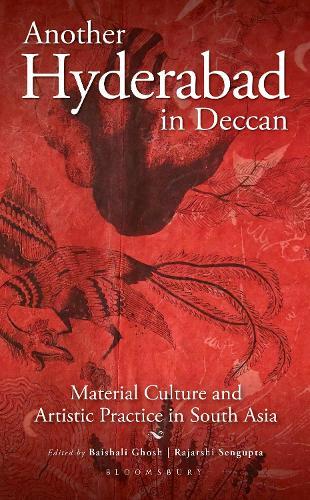
Full Product Details
Author: Dr Baishali Ghosh (University of Hyderabad, India) ,
Dr Rajarshi Sengupta (Indian Institute of Technology, Kanpur, India)
Publisher: Bloomsbury Publishing India Pvt Ltd
Imprint: Bloomsbury Academic India
Dimensions:
Width: 14.00cm
, Height: 2.00cm
, Length: 22.20cm
Weight: 0.460kg
ISBN: 9789361317774
ISBN 10: 9361317776
Pages: 296
Publication Date: 30 October 2025
Audience:
Professional and scholarly
,
Professional & Vocational
Format: Hardback
Publisher's Status: Active
Availability: To order

Stock availability from the supplier is unknown. We will order it for you and ship this item to you once it is received by us.
Reviews
This fascinating anthology uncovers history that has escaped the grip of institutional archives. The authors offer an archaeology of varied artistic and craft practices as an alternative vision of Hyderabad and the Deccan, post-independence. There is not just one Hyderabad. The authors unveil the Deccani multiplicity by drawing on minority histories to resist the dominance of a singular narrative. The recognition of deep involvement of communities in shaping the many-layered facets of cities serves as an important methodological invitation to all researchers. This ‘contextual conversation’ offers an exchange between dominant and subaltern historical accounts. The book thus provides the groundwork for a rediscovery of cities by focusing on the interactive and intersected material and artistic practices—a must-read for all students of crafts, arts, heritage and cities. -- Professor Wiebe E. Bijker, Maastricht University, The Netherlands In this thought provoking volume, a new generation of scholars asks new questions using innovative sources and methodologies to explore the visual and material culture of the Deccan’s storied past. A much too storied past. Peeling back layers of colonial narrative and received wisdoms, the nine chapters compel us to consider unacknowledged and understudied Decanni multiplicities, going beyond the archive to bring forth the voices, intentionalities and movements of marginalised artisans and communities, from vernacular Islamic architecture, to Dravida temple painters, to influential 21st century weavers. A model for knowledge producers everywhere seeking alternative ways to envision the historical past. -- Sarah Fee Ph.D., Senior Curator, Global Fashion & Textiles, Royal Ontario Museum, Toronto, Associate Professor (status only), Dept. of Art History University of Toronto
Author Information
Baishali Ghosh teaches art history and visual studies at the University of Hyderabad. Her research explores migration theories and material culture, investigating the process, production and circulation of the South Asian imageries. Her recent publications include ‘Notes on Death Pictures on the Roads of Hyderabad’ (2022) and ‘Thinking through the Residual Shrines on the Roads of SEZ Hyderabad’ (2023). Rajarshi Sengupta is a practitioner and art historian, presently an assistant professor in fine arts, Dept. of Humanities and Social Sciences, Indian Institute of Technology (IIT) Kanpur (2021). Sengupta received his PhD in art history from the University of British Columbia, Vancouver (2019). His thesis reconstructed the undertheorized histories of the kalamkari textile makers of the Coromandel and Deccan. He received the IARTS Textiles of India Grant, Royal Ontario Museum, Toronto (2017-18), Indo-Canadian Shastri Travel Grant (2023-24), and has published on Deccani textile histories in the Journal of Textile Design Research and Practice, Journal18 and South Asian Studies.