|
|
|||
|
||||
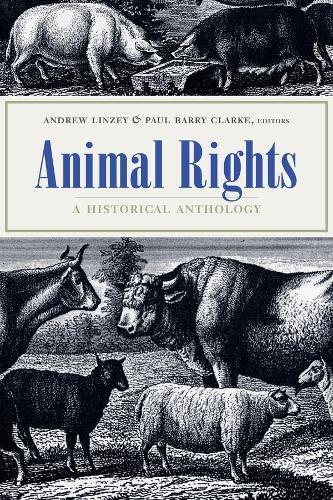
OverviewThis comprehensive and diverse anthology, the only one of its kind, illuminates the complex evolution of moral thought regarding animals and includes writings from ancient Greece to the present. Animal Rights reveals the ways in which a variety of thinkers have addressed such issues as our ethical responsibilities for the welfare of animals, whether animals have rights, and what it means to be human. Full Product DetailsAuthor: Andrew Linzey , Paul Barry ClarkePublisher: Columbia University Press Imprint: Columbia University Press Dimensions: Width: 21.10cm , Height: 1.70cm , Length: 14.00cm Weight: 0.326kg ISBN: 9780231134200ISBN 10: 0231134207 Pages: 256 Publication Date: 14 December 2004 Audience: Professional and scholarly , Professional & Vocational Format: Hardback Publisher's Status: Active Availability: Out of stock The supplier is temporarily out of stock of this item. It will be ordered for you on backorder and shipped when it becomes available. Language: English Table of ContentsForeword Beyond caricature: preface to the Columbia University press edition Pt. I. Differences between humans and animals 1. Creation of the universe 2. Animals are not political 3. Animals are not rational creatures 4. The human and the beast 5. Animals as automata 6. Animals have no language 7. Understanding in animals 8. A response to Locke 9. Of the reason of animals 10. On animal souls 11. Freedom of the will 12. Organic difference 13. Animals have no concepts 14. Animals are not self-aware 15. An animal is not a species being 16. On the genius of species 17. The lure of the simple distinction Pt. II. Dominion and the limits to power 1. The golden age 2. Animals are for our use 3. Rational domination 4. Unrestricted dominion 5. Difference does not justify domination 6. Animals in the cosmic hierarchy 7. The right of nature 8. Dominion is subject to law 9. The workmanship model 10. Responsibility to the weak 11. Animals do not make war on humans 12. Animals may be used 13. Dominion and property 14. The limits to power 15. Animals as utilities 16. Nature teaches mutual aid 17. Dominion as power 18. Critique of the principle of domination 19. Dominion is social Pt. III. Justice, rights and obligations 1. Justice requires friendship 2. No friendship with irrational creatures 3. Exclusion from friendship is not rational 4. The government of animals 5. Animals have no intrinsic rights 6. Cruelty is not natural 7. No justice without equality 8. Differences do not justify inequality 9. Duties to animals are indirect 10. Animals are not constitutional persons 11. The inalienable rights of animals 12. All nature suffers 13. Limits to the rights over animals 14. Duty to minimize suffering 15. Duties to animals are direct 16. The principle of animal rights 17. Pity for animals 18. Duties to life 19. Outside the scope of the theory of justice 20. The rights of animals 21. All animals are equal 22. Constraints and animals 23. The feminist challenge 24. The struggle for animal rightsReviewsThe anthology adds a much-needed historical depth to current controversies. BMS Book News: Interaction 4/1/05 This volume well serves the purposes that the editors set for it. -- David Corner Between the Species 8/1/07 """The anthology adds a much-needed historical depth to current controversies."" -- BMS Book News: Interaction ""This volume well serves the purposes that the editors set for it."" -- David Corner, Between the Species" The anthology adds a much-needed historical depth to current controversies. -- BMS Book News: Interaction This volume well serves the purposes that the editors set for it. -- David Corner, Between the Species Author InformationAndrew Linzey is a member of the Faculty of Theology, Oxford University, and Bede Jarrett Senior Research Fellow at Blackfriars. He is also honorary professor in theology at Birmingham University and special professor at Saint Xavier University, Chicago. He has written or edited twenty books, including Aninal Theology, Animal Rites: Liturgies of Animal Care, and Animals on the Agenda: Questions about Animals for Theology and Ethics. Paul Barry Clarke, as a teacher and researcher in the Department of Government at the University of Essex, has written and edited over twelve books in political philosophy. He is the author of Autonomy Unbound, Deep Citizenship, and Citizenship, and has recently coedited and contributed to the Encyclopedia of Democratic Thought. Tab Content 6Author Website:Countries AvailableAll regions |
||||