Overview
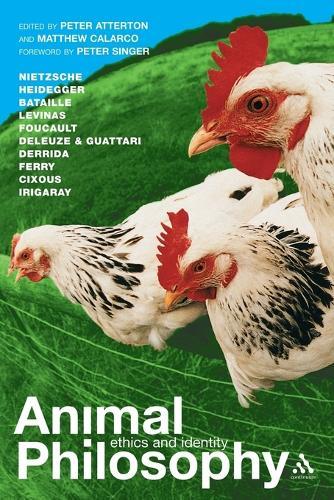
Animal Philosophy is the first text to look at the place and treatment of animals in Continental thought. A collection of essential primary and secondary readings on the animal question, it brings together contributions from the following key Continental thinkers: Nietzsche, Heidegger, Bataille, Levinas, Foucault, Deleuze, Guattari, Derrida, Ferry, Cixous, and Irigaray. Each reading is followed by commentary and analysis from a leading contemporary thinker. The coverage of the subject is exceptionally broad, ranging across perspectives that include existentialism, poststructuralism, postmodernism, phenomenology and feminism. This anthology is an invaluable one-stop resource for anyone researching, teaching or studying animal ethics and animal rights in the fields of philosophy, cultural studies, literary theory, sociology, environmental studies and gender and women's studies.
Full Product Details
Author: Peter Atterton ,
Professor Matthew Calarco ,
Peter Singer
Publisher: Bloomsbury Publishing PLC
Imprint: Continuum International Publishing Group Ltd.
Dimensions:
Width: 15.40cm
, Height: 1.60cm
, Length: 23.40cm
Weight: 0.396kg
ISBN: 9780826464149
ISBN 10: 0826464149
Pages: 256
Publication Date: 30 May 2004
Audience:
College/higher education
,
Professional and scholarly
,
Tertiary & Higher Education
,
Professional & Vocational
Format: Paperback
Publisher's Status: Active
Availability: Manufactured on demand

We will order this item for you from a manufactured on demand supplier.
Language: English
Reviews
This much-needed volume will hopefully serve to encourage interest in the zoopolitical impact of these thinkers. Overall, the collected abstracts are generally well chosen. The range is broad.... The commentaries vary in their clarity and helpfulness, but on the whole are excellent. Animal Philosophy successfully accomplishes its goal - to be, as its blurb says, 'an invaluable one-stop resource for anyone researching, teaching or studying animal ethics'. In assembling these various writings, whose dispersion has too often allowed them to go unnoticed, the editors have provided a means by which the Continental voice can be more fully heard in philosophical debates regarding animals. Indeed, if we take as criteria not simply the presence of concern for animals, but rather the potential for incisive theoretical tools - ethical theories that include the nonhuman, social analytics that see the nonhuman, literary methods that write the nonhuman - we may find the diverse and difficult modes of thought offered to be uniquely valuable sources of insight. - The Bible and Critical Theory , Vol. 1 No. 2, 2005--Sanford Lakoff
Animal Philosophy is a collection of essential primary and secondary readings on the animal question . Animal Philosophy was in many ways inspired by the tremendous advances the Anglo-American philosophical tradition has made regarding the animal question over the last thirty years or so The selections Atterton and Calarco have chosen are not exhaustive, but they are exemplary, and they constitute in every case their most sustained treatments of the animal topic. They set out the terms of the debate in a way that is most likely to be useful for scholars and students working in the field of Continental philosophy and/or coming to the animal question for the first time. They open up new vistas for research The quality of originality about each of the readings is what prompted the editors to provide a critical commentary by distinguished scholars in the field following each reading .On ethics and identity, this anthology, Animal Philosophy, is an invaluable one-stop resource for anyone re
This much-needed volume will hopefully serve to encourage interest in the zoopolitical impact of these thinkers. Overall, the collected abstracts are generally well chosen. The range is broad.... The commentaries vary in their clarity and helpfulness, but on the whole are excellent. Animal Philosophy successfully accomplishes its goal - to be, as its blurb says, 'an invaluable one-stop resource for anyone researching, teaching or studying animal ethics'. In assembling these various writings, whose dispersion has too often allowed them to go unnoticed, the editors have provided a means by which the Continental voice can be more fully heard in philosophical debates regarding animals. Indeed, if we take as criteria not simply the presence of concern for animals, but rather the potential for incisive theoretical tools - ethical theories that include the nonhuman, social analytics that see the nonhuman, literary methods that write the nonhuman - we may find the diverse and difficult modes of thought offered to be uniquely valuable sources of insight. - The Bible and Critical Theory , Vol. 1 No. 2, 2005--,
In Animal Philosophy: Ethics and Identity, editors Peter Atterton and Matthew Calarco collect some of the more germane writings on animals from a range of prominent Continental philosophers...The collection introduces novel approaches to lingering philosophical questions about animals' ontological and ethical status, but it also included hermeneutic approaches to our deployment of animal symbols, phenomenological reflections on human encounters and relationships with animals, and deconstructive linguistic analyses of designations such as animal. Animal Philosophy fills a gap in literature, for while most of the works excerpted here have been available in translation for some time, no entire volume had been dedicated explicitly to how these writers address these questions...The commentary contains helpful measure of exegesis and critique. The essays offered by the editors are exceptionally valuable...For readers interested in Continental philosophy, the animal question, or both, this volume is a welcome arrival. --Janus Head, Summer 2005 -- Janus Head Animal Philosophy is a collection of essential primary and secondary readings on the animal question.... Animal Philosophy was in many ways inspired by the tremendous advances the Anglo-American philosophical tradition has made regarding the animal question over the last thirty years or so... The selections Atterton and Calarco have chosen are not exhaustive, but they are exemplary, and they constitute in every case their most sustained treatments of the animal topic. They set out the terms of the debate in a way that is most likely to be useful for scholars and students working in the field of Continental philosophy and/or coming to the animal question for the first time. They open up new vistas for research... The quality of originality about each of the readings is what prompted the editors to provide a critical commentary by distinguished scholars in the field following each reading....On ethics and identity, this anthology, Animal Philosophy, is an invaluable one-stop resource for anyone researching, teaching or studying animal ethics and animal rights in the fields of philosophy, cultural studies, literary theory, sociology, environmental studies and gender and women's studies. The coverage of the subject is exceptionally broad, ranging across perspectives that include existentialism, poststructuralism, postmodernism, phenomenology and feminism. Readers will find Animal Philosophy stimulating and provocative. -SirReadaLot.org, August 27, 2004 -- SirReadALot.org This much-needed volume will hopefully serve to encourage interest in the zoopolitical impact of these thinkers. Overall, the collected abstracts are generally well chosen. The range is broad.... The commentaries vary in their clarity and helpfulness, but on the whole are excellent. Animal Philosophy successfully accomplishes its goal - to be, as its blurb says, 'an invaluable one-stop resource for anyone researching, teaching or studying animal ethics'. In assembling these various writings, whose dispersion has too often allowed them to go unnoticed, the editors have provided a means by which the Continental voice can be more fully heard in philosophical debates regarding animals. Indeed, if we take as criteria not simply the presence of concern for animals, but rather the potential for incisive theoretical tools - ethical theories that include the nonhuman, social analytics that see the nonhuman, literary methods that write the nonhuman - we may find the diverse and difficult modes of thought offered to be uniquely valuable sources of insight. - The Bible and Critical Theory, Vol. 1 No. 2, 2005 -- The Bible and Critical Theory
Author Information
Peter Atterton teaches in the Deaprtment of Philosophy at the University of San Diego. Matthew Calarco is Assistant Professor of Philosophy at Sweet Briar College.