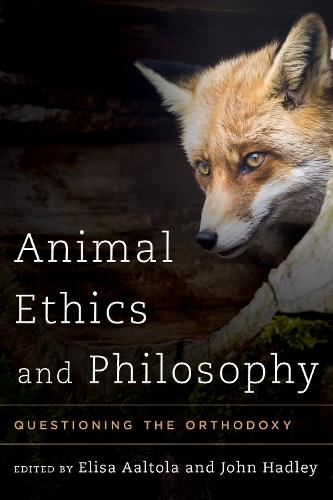
Full Product Details
Author: Elisa Aaltola ,
John Hadley
Publisher: Bloomsbury Publishing PLC
Imprint: Rowman & Littlefield International
Dimensions:
Width: 16.30cm
, Height: 2.20cm
, Length: 23.70cm
Weight: 0.467kg
ISBN: 9781783481811
ISBN 10: 1783481811
Pages: 236
Publication Date: 01 December 2014
Audience:
Professional and scholarly
,
Professional & Vocational
Format: Hardback
Publisher's Status: Active
Availability: In Print

This item will be ordered in for you from one of our suppliers. Upon receipt, we will promptly dispatch it out to you. For in store availability, please contact us.
Reviews
This is a very original book which examines new paths for studies in nonhuman animals and moral philosophy. Addressing issues concerning animal ethics in metaethics, metaphilosophy, epistemology and moral psychology, it offers a previously unexplored approach. -- Oscar Horta, University of Santiago de Compostela
This is a very original book which examines new paths for studies in nonhuman animals and moral philosophy. Addressing issues concerning animal ethics in metaethics, metaphilosophy, epistemology and moral psychology, it offers a previously unexplored approach. -- Oscar Horta, University of Santiago de Compostela Aaltola and Hadley have rounded up some of their most gifted contemporaries to push the boundaries and rejuvenate some of the old debates. An exciting read for all those who care about ethics and animals. -- Dale Jamieson, Professor of Environmental Studies and Philosophy, New York University The essays that constitute Animal Ethics and Philosophy: Questioning the Orthodoxy accomplish at least two things: first, they provide a long-overdue critical reconceptualization and sharp meta-analysis of assumptions foundational to contemporary animal ethics; second and most importantly, they construct fresh, original, innovative paradigms for future research in animal ethics. -- Robert C. Jones, Assistant Professor of Philosophy, California State University
Editors Aaltola and Hadley identify the motivation for this collection of essays as the fact that there is very little innovation in the field of animal ethics; much fits the description of 'moral extensionism,' or the extension of existing moral and political theories across species. The editors present works that examine the metaethical and meta-philosophical issues in animal ethics, thereby asking unaddressed questions. In the book's 12 essays, various contributors focus on the assumptions behind the critique of morally relevant relationships; offer an application of biosemiotics, or living organisms' use of signs; and utilize Merleau-Ponty's embodied subjects to discuss intersubjectivity with non-human animals. Authors also examine the epistemological and ethical difficulties regarding speaking for animals, argue there is a shortsightedness in basing animal ethics in rights, and consider the moral role of disgust with animal abuse. Finally, Aaltola ends with a convincing explanation for how and why humans are able to paradoxically love some animals and eat others. . . .Readers will find original additions to the animal ethics discussion. Summing Up: Recommended. Upper-division undergraduates through researchers and faculty. * CHOICE * This is a very original book which examines new paths for studies in nonhuman animals and moral philosophy. Addressing issues concerning animal ethics in metaethics, metaphilosophy, epistemology and moral psychology, it offers a previously unexplored approach. -- Oscar Horta, University of Santiago de Compostela Aaltola and Hadley have rounded up some of their most gifted contemporaries to push the boundaries and rejuvenate some of the old debates. An exciting read for all those who care about ethics and animals. -- Dale Jamieson, New York University, Professor of Environmental Studies and Philosophy The essays that constitute Animal Ethics and Philosophy: Questioning the Orthodoxy accomplish at least two things: first, they provide a long-overdue critical reconceptualization and sharp meta-analysis of assumptions foundational to contemporary animal ethics; second and most importantly, they construct fresh, original, innovative paradigms for future research in animal ethics. -- Robert C. Jones, Assistant Professor of Philosophy, California State University
Editors Aaltola and Hadley identify the motivation for this collection of essays as the fact that there is very little innovation in the field of animal ethics; much fits the description of 'moral extensionism,' or the extension of existing moral and political theories across species. The editors present works that examine the metaethical and meta-philosophical issues in animal ethics, thereby asking unaddressed questions. In the book's 12 essays, various contributors focus on the assumptions behind the critique of morally relevant relationships; offer an application of biosemiotics, or living organisms' use of signs; and utilize Merleau-Ponty's embodied subjects to discuss intersubjectivity with non-human animals. Authors also examine the epistemological and ethical difficulties regarding speaking for animals, argue there is a shortsightedness in basing animal ethics in rights, and consider the moral role of disgust with animal abuse. Finally, Aaltola ends with a convincing explanation for how and why humans are able to paradoxically love some animals and eat others...Readers will find original additions to the animal ethics discussion. Summing Up: Recommended. Upper-division undergraduates through researchers and faculty. CHOICE This is a very original book which examines new paths for studies in nonhuman animals and moral philosophy. Addressing issues concerning animal ethics in metaethics, metaphilosophy, epistemology and moral psychology, it offers a previously unexplored approach. -- Oscar Horta, University of Santiago de Compostela Aaltola and Hadley have rounded up some of their most gifted contemporaries to push the boundaries and rejuvenate some of the old debates. An exciting read for all those who care about ethics and animals. -- Dale Jamieson, Professor of Environmental Studies and Philosophy, New York University The essays that constitute Animal Ethics and Philosophy: Questioning the Orthodoxy accomplish at least two things: first, they provide a long-overdue critical reconceptualization and sharp meta-analysis of assumptions foundational to contemporary animal ethics; second and most importantly, they construct fresh, original, innovative paradigms for future research in animal ethics. -- Robert C. Jones, Assistant Professor of Philosophy, California State University
Author Information
Elisa Aaltola is senior lecturer in philosophy at the University of Eastern Finland. She is the author of Animal Suffering: Philosophy and Culture (Palgrave, 2012) and more than twenty refereed papers on animal philosophy. John Hadley is lecturer in philosophy at the University of Western Sydney, Australia. He has published papers on a wide range of topics in animal and environmental ethics.