|
|
|||
|
||||
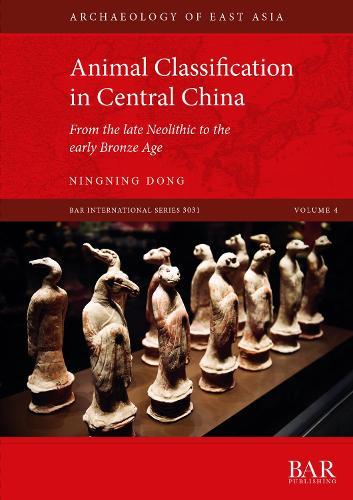
OverviewThis monograph uses an archaeological approach to decipher folk classification of animals in ancient societies. Ningning Dong collates faunal data from three late Neolithic and early Bronze Age sites in central China and integrates multiple lines of evidence. The analyses demonstrate a folk taxonomy remarkably different from the Linnaean system. The results show that age might have served as a critical categorical filter, particularly in ritual contexts, and that the wild/domesticated dichotomy was established no earlier than the Shang dynasty. This perceptual distinction is unlikely to have been synchronised with the initial occurrence of domestication in the early Neolithic. Animal categories constituted a vital part of a broader classificatory scheme that concerned the organisation of the cosmos as a whole. This book enriches our understanding of animal categories in ancient China and further discusses the tension between etics and emics, language and action, domestic and wild. Full Product DetailsAuthor: Ningning DongPublisher: BAR Publishing Imprint: BAR Publishing Weight: 0.574kg ISBN: 9781407357928ISBN 10: 1407357921 Pages: 144 Publication Date: 30 July 2021 Audience: Professional and scholarly , Professional & Vocational Format: Paperback Publisher's Status: Active Availability: Available To Order We have confirmation that this item is in stock with the supplier. It will be ordered in for you and dispatched immediately. Table of ContentsList of Figures List of Tables Foreword Abstract 1. Introduction 1.1 Taxonomy in zooarchaeology: a reconsideration 1.2 Anthropological approaches to taxonomy 1.2.1 Formalism: general principles 1.2.2 Cultural relativism: contextual variables 1.2.3 Tackling the tension 1.3 Previous studies on folk taxonomy: from anthropology to archaeology 1.4 Linnaean taxonomy and taxonomies in ancient China revisited 1.4.1 Linnaean taxonomy 1.4.2 Taxonomies in ancient China 1.5 Problems of cross-reference 1.5.1 Over-identification and under-identification 1.5.2 Changeable category 1.5.3 Animals excluded from Linnaean taxonomy 1.6 Setting of the book: research question, region and period 1.7 Research themes 1.7.1 Etic and emic: two perspectives 1.7.2 Formalism and relativism: two approaches 1.7.3 Language and action: two pathways 1.7.4 Domesticated and wild: two categories 1.8 Structure of the book 2. Developing an Archaeological Approach: Materials and Methods 2.1 Animal categories and archaeological depositions 2.1.1 Two examples: taxonomic intention and depositional practice 2.1.2 Structured deposition: definition 2.1.3 Intentionality 2.2 Contextual archaeology 2.3 Zooarchaeological materials 2.4 Zooarchaeological methods 2.4.1 Identification and recording 2.4.2 Quantification 2.4.3 Reconstruction of data Fragmentation Age-at-death Taxonomic composition Body element distribution Associated bone group (ABG) 2.5 Analysis of contexts 2.5.1 Spatial analysis 2.5.2 Isotope data 2.5.3 Lexical indication and written record 2.6 Summary 3. Central China from the Late Neolithic to the Early Bronze Age: an Archaeological Background 3.1 Archaeological information 3.1.1 Late Longshan period 3.1.2 Xinzhai period 3.1.3 Erlitou period 3.1.4 Erligang period 3.1.5 Research period: an overview 3.2 Archaeological interpretation: terminology and approach 3.2.1 Dynasty and historiographical tradition 3.2.2 Civilisation and nationalism 3.2.3 State and neo-evolutionary models 3.2.4 Relational studies: an alternative 3.3 Animals at the archaeological sites 3.3.1 Deer (Cervidae) 3.3.2 Dog (Canis lupus familiaris) 3.3.3 Pig (Sus scrofa domesticus) 3.3.4 Cattle (Bos taurus) 3.3.5 Sheep and goat (Ovis aries and Capra hircus) 3.3.6 Horse (Equus ferus caballus) 3.4 Animal images in artifacts 3.5 Beastly question and domesticated scholarship: a summary 4. Animal Classification at Wadian 4.1 Wadian: site introduction 4.1.1 Chronology and phasing 4.1.2 Spatial layout and feature types 4.1.3 Archaeological assemblages 4.2 Previous zooarchaeological studies 4.3 Results 4.3.1 Fragmentation 4.3.2 Body element distribution 4.3.3 Age profile 4.3.4 Presence of human bones 4.3.5 Pig-deer index 4.3.6 Associated bone group 4.3.7 Scatter plot of combination of two variables 4.4 Discussion 4.4.1 Area themes 4.4.2 Site formation processes 4.4.3 Temporal change of category 4.4.4 Spatial association between pig and longhouse 4.4.5 Subdivision within 'pig' category Age binary classification Domesticated versus wild Cross-classification of pig Animal individual versus animal product 4.5 Summary of animal categories at Wadian 5. Animal Classification at Wangchenggang 5.1 Wangchenggang: site introduction 5.1.1 Chronology and phasing 5.1.2 Spatial layout and feature types 5.1.3 Wangchenggang and its regional network 5.2 Previous zooarchaeological studies 5.3 Results 5.3.1 Animal taxa Pig Deer Sheep Cattle Other mammals 5.3.2 Presence of human bones 5.3.3 Fragmentation 5.3.4 Body element distribution 5.3.5 Associated bone group 5.3.6 Age profile 5.3.7 Bone modification 5.3.8 Type of deposition Multi-skeleton-increment deposition Formal tomb Refuse deposition 5.4 Discussion 5.4.1 Animal exploitation and classification 5.4.2 Age as a classificatory filter 5.4.3 Subgroups of human being 5.5 Summary of animal categories at Wangchenggang 6. Animal Classification at Xinzhai 6.1 Xinzhai: site introduction 6.1.1 Chronology and phasing 6.1.2 Spatial layout and feature types 6.1.3 Xinzhai site and its regional network 6.2 Previous zooarchaeological studies 6.3 Results 6.3.1 Animal taxa Pig Deer Cattle Sheep and goat Other non-human mammals Human 6.3.2 Body element distribution 6.3.3 Age profile 6.3.4 Associated bone group 6.3.5 Type of deposition Layer and feature depositions Internal and external depositions Young and adult depositions Type of deposition 6.3.6 Summary of isotope data 6.4 Discussion 6.4.1 Exploitation of animal resources 6.4.2 Status of deer Manipulation of deer Purposes of manipulation Hunting and deer category 6.4.3 Age as a classificatory filter 6.4.4 Classification of animals and spaces Spatial layout and area themes Categorical separation and conceptual segregation 6.5 Summary of animal categories at Xinzhai 7. Animal Categories: a Synthesis 7.1 Human versus non-human classification 7.2 Age categories 7.2.1 AgReviews'Dong Ningning's prominent contribution to the field makes a breakthrough in constructing animal classifications, human categories, and social conceptions associated with taxonomies in the past. The thought provoking issues Dong raises challenge the traditional approach to archaeology and her innovative methodological approach provides a solid foundation for researchers to build upon.' You Yue, Asian Perspectives Vol 62.1, 2023 'It is by far the most original approach to Chinese zooarchaeology I have ever seen. The data for all of the sites in the report has been published elsewhere, but the analyses are new. The value lies in the introduction of a new approach.' Peer reviewer 'No one has conducted research on this topic in China before, so the overall framework and analysis can be regarded as a new way of zooarchaeological study.' Dr Hao Zhao, Peking University {\rtf1\fbidis\ansi\ansicpg1252\deff0\deflang2057{\fonttbl{\f0\fswiss\fprq2\fcharset0 Calibri;}{\f1\fnil\fcharset0 Verdana;}} \viewkind4\uc1\pard\ltrpar\sa160\sl252\slmult1\lang1033\kerning2\f0\fs22\lquote Dong Ningning\rquote s prominent contribution to the field makes a breakthrough in constructing animal classifications, human categories, and social conceptions associated with taxonomies in the past. The thought provoking issues Dong raises challenge the traditional approach to archaeology and her innovative methodological approach provides a solid foundation for researchers to build upon.\rquote You Yue, Asian Perspectives Vol 62.1, 2023\lang2057\kerning0\par \lquote It is by far the most original approach to Chinese zooarchaeology I have ever seen. The data for all of the sites in the report has been published elsewhere, but the analyses are new. The value lies in the introduction of a new approach.\rquote Peer reviewer\par \pard\ltrpar\lquote No one has conducted research on this topic in China before, so the overall framework and analysis can be regarded as a new way of zooarchaeological study.\rquote Dr Hao Zhao, Peking University\par \par \pard\ltrpar\sa160\sl252\slmult1\par \pard\ltrpar\f1\fs17\par } 'It is by far the most original approach to Chinese zooarchaeology I have ever seen. The data for all of the sites in the report has been published elsewhere, but the analyses are new. The value lies in the introduction of a new approach.' Peer reviewer 'No one has conducted research on this topic in China before, so the overall framework and analysis can be regarded as a new way of zooarchaeological study.' Dr Hao Zhao, Peking University Author InformationNingning Dong is a junior research fellow at the Institute of Archaeological Science, Fudan University, China. She was awarded her PhD in archaeology from University of Cambridge, UK. Her main research interests include the zooarchaeology of early China, isotope analysis for husbandry strategies and subsistence in frontier regions. Tab Content 6Author Website:Countries AvailableAll regions |
||||