Overview
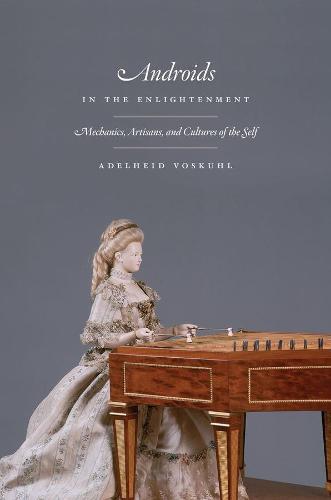
The eighteenth century saw the creation of a number of remarkable mechanical androids: at least ten prominent automata were built between 1735 and 1810 by clockmakers, court mechanics, and other artisans from France, Switzerland, Austria, and the German lands. Designed to perform sophisticated activities such as writing, drawing, or music making, these “Enlightenment automata” have attracted continuous critical attention from the time they were made to the present, often as harbingers of the modern industrial age, an era during which human bodies and souls supposedly became mechanized. In Androids in the Enlightenment, Adelheid Voskuhl investigates two such automata—both depicting piano-playing women. These automata not only play music, but also move their heads, eyes, and torsos to mimic a sentimental body technique of the eighteenth century: musicians were expected to generate sentiments in themselves while playing, then communicate them to the audience through bodily motions. Voskuhl argues, contrary to much of the subsequent scholarly conversation, that these automata were unique masterpieces that illustrated the sentimental culture of a civil society rather than expressions of anxiety about the mechanization of humans by industrial technology. She demonstrates that only in a later age of industrial factory production did mechanical androids instill the fear that modern selves and societies had become indistinguishable from machines.
Full Product Details
Author: Adelheid Voskuhl
Publisher: The University of Chicago Press
Imprint: University of Chicago Press
Dimensions:
Width: 1.70cm
, Height: 0.20cm
, Length: 2.30cm
Weight: 0.595kg
ISBN: 9780226034027
ISBN 10: 022603402
Pages: 296
Publication Date: 31 May 2013
Audience:
College/higher education
,
Postgraduate, Research & Scholarly
Format: Hardback
Publisher's Status: Active
Availability: Manufactured on demand

We will order this item for you from a manufactured on demand supplier.
Reviews
"""This deeply researched study restores Enlightenment automata to their original context of princely courts, protoindustrial craftsmanship, and bourgeois sentiment - and explains how automata later came to stand for industrial machinery, mechanical theories of organic life, and fatally accurate simulacra of human beings in the philosophy and literature of the nineteenth and twentieth centuries. Adelheid Voskuhl's panoramic study is a model of how the history of technology can illuminate cultural and intellectual history."" (Lorraine Daston, Max Planck Institute for the History of Science)"""
This deeply researched study restores Enlightenment automata to their original context of princely courts, protoindustrial craftsmanship, and bourgeois sentiment--and explains how automata later came to stand for industrial machinery, mechanical theories of organic life, and fatally accurate simulacra of human beings in the philosophy and literature of the nineteenth and twentieth centuries. Adelheid Voskuhl's panoramic study is a model of how the history of technology can illuminate cultural and intellectual history. <br>--Lorraine Daston, Max Planck Institute for the History of Science
Author Information
Adelheid Voskuhl is associate professor in the Department of the History of Science at Harvard University.