Overview
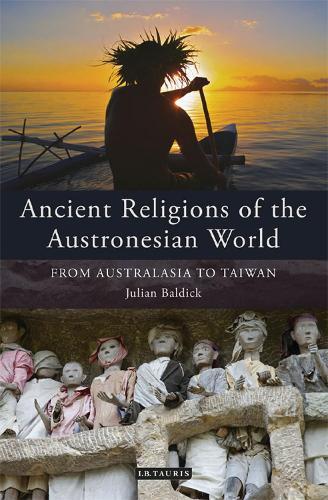
Austronesia is the vast oceanic region which stretches from Madagascar to Taiwan to New Zealand. Encompassing both scattered archipelagos and major landmasses, Austronesia - derived from the Latin australis,'southern',and Greek nesos,'island' - is used primarily as a linguistic term, designating a family of languages spoken by peoples with a shared heritage. Julian Baldick, a celebrated historian of ancient religion, here argues that the diverse inhabitants of the Philippines, Taiwan, Indonesia, New Guinea and Oceania show a common inheritance that extends beyond language. This commonality is found above all in mythology and ritual, which reach back to an ancient, prehistoric past. From around 1250 BCE the original proto-Oceanic speakers migrated eastwards from South-East Asia. Navigating by the sun, the stars, bird flight, the swells of the sea and cloud-swathed mountain islands, Austronesian voyagers used canoes and outriggers to settle on new territories. They developed a unified pattern of religion characterised by mortuary rites, headhunting and agrarian rituals of the annual calendar, culminating in a post-harvest festival often sexual in nature. This unique overview of Austronesian belief and tradition - the author's final book, and published posthumously - will be essential reading for students of religion, prehistory and anthropology.
Full Product Details
Author: Julian Baldick
Publisher: Bloomsbury Publishing PLC
Imprint: I.B. Tauris
Dimensions:
Width: 16.40cm
, Height: 2.20cm
, Length: 23.60cm
Weight: 0.540kg
ISBN: 9781780763668
ISBN 10: 1780763662
Pages: 256
Publication Date: 07 May 2013
Audience:
General/trade
,
General
Format: Hardback
Publisher's Status: Active
Availability: Manufactured on demand

We will order this item for you from a manufactured on demand supplier.
Reviews
'Julian Baldick seeks to do for the Austronesian world, which ranges from Taiwan to Australasia, what Georges Dumezil sought to do for the Indo-European world: show a once unified culture. Like Dumezil, who is his inspiration, Baldick starts with language but then extends language to culture as a whole, and to religion in particular. Again following Dumezil, Baldick offers a tripartite scheme, but one that fits the distinctiveness of Austronesia: mortuary rituals, headhunting, and agrarian rituals tied to the calendar. Baldick is not the first to propose a unified culture for this area, but he systematically brings together the many disparate studies of individual peoples to make the strongest case to date for a uniquely Austronesian cultural domain.' Robert A Segal, Sixth Century Professor of Religious Studies, University of Aberdeen 'This is a book inspired by the great French Indo-European comparativist, Georges Dumezil. It is an attempt to identify central features of early Austronesian religious life: first, a deep concern with incorporative mortuary rituals that generally included secondary burial; second, an associated commitment to headhunting to bolster prosperity and community prestige; and third, the performance of agrarian rituals linked to hunting whose emphasis was on human fertility. To illustrate these ancient Austronesian religious ideas, Julian Baldick has selectively surveyed a considerable ethnographic literature covering the Austronesian populations from Madagascar to Hawaii to document the diverse and varied evidence that can be considered as lingering refractions of an earlier Austronesian way of life. This is a book with a broad sweep that retains its clear focus. It is a welcome endeavour and will undoubtedly stimulate further comparative Austronesian research.' James J Fox, Professor, Research School of Asia and the Pacific, The Australian National University
'Julian Baldick seeks to do for the Austronesian world, which ranges from Taiwan to Australasia, what Georges Dumezil sought to do for the Indo-European world: show a once unified culture. Like Dumezil, who is his inspiration, Baldick starts with language but then extends language to culture as a whole, and to religion in particular. Again following Dumezil, Baldick offers a tripartite scheme, but one that fits the distinctiveness of Austronesia: mortuary rituals, headhunting, and agrarian rituals tied to the calendar. Baldick is not the first to propose a unified culture for this area, but he systematically brings together the many disparate studies of individual peoples to make the strongest case to date for a uniquely Austronesian cultural domain.' - Robert A Segal, Sixth Century Professor of Religious Studies, University of Aberdeen
Author Information
Julian Baldick (1950-2012) was formerly Reader in the Study of Religions at King's College London. He was the author of Homer and the Indo-Europeans: Comparing Mythologies; Imaginary Muslims: The Uwaysi Sufis of Central Asia; Black God: The Afroasiatic Roots of the Jewish, Christian and Muslim Religions; Mystical Islam: An Introduction to Sufism (new edition, 2012) and Animal and Shaman: Ancient Religions of Central Asia (new edition, 2012), all published by I.B.Tauris.