Overview
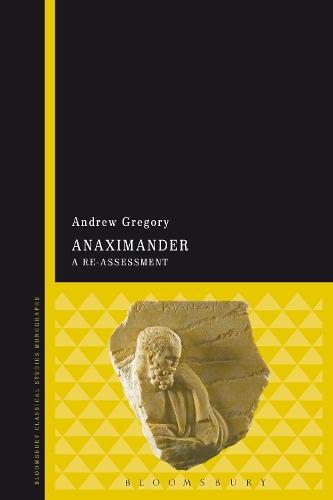
Anaximander, the sixth-century BCE philosopher of Miletus, is often credited as being the instigator of both science and philosophy. The first recorded philosopher to posit the idea of the boundless cosmos, he was also the first to attempt to explain the origins of the world and humankind in rational terms. Anaximander's philosophy encompasses theories of justice, cosmogony, geometry, cosmology, zoology and meteorology. Anaximander: A Re-assessment draws together these wide-ranging threads into a single, coherent picture of the man, his worldview and his legacy to the history of thought. Arguing that Anaximander's statements are both apodeictic and based on observation of the world around him, Andrew Gregory examines how Anaximander's theories can all be construed in such a way that they are consistent with and supportive of each other. This includes the tenet that the philosophical elements of Anaximander's thought (his account of the apeiron, the extant fragment) can be harmonised to support his views on the natural world. The work further explores how these theories relate to early Greek thought and in particular conceptions of theogony and meterology in Hesiod and Homer.
Full Product Details
Author: Andrew Gregory (University College London, UK)
Publisher: Bloomsbury Publishing PLC
Imprint: Bloomsbury Academic
Dimensions:
Width: 15.60cm
, Height: 1.90cm
, Length: 23.40cm
Weight: 0.617kg
ISBN: 9781472507792
ISBN 10: 1472507797
Pages: 312
Publication Date: 25 February 2016
Audience:
College/higher education
,
Undergraduate
,
Postgraduate, Research & Scholarly
Format: Hardback
Publisher's Status: Active
Availability: Manufactured on demand

We will order this item for you from a manufactured on demand supplier.
Reviews
Andrew Gregory's Anaximander: A Re-assessment is well-argued book that gives us a systematic Anaximander with a network of connecting views on the well-ordered nature of things, including zoogony, meteorology, cosmology, and astronomy. Gregory's careful analysis of ancient texts and modern interpretations is a boon for students and for anyone interested in the beginnings of Greek philosophy and science. -- Patricia Curd, Professor of Philosophy, Purdue University, USA Gregory's Anaximander describes how the first great Greek cosmologist looks back to his poetic predecessors and how later thinkers, particularly Plato, look back to him. By emphasizing the stability, symmetry, and order of Anaximander's system and its integration of natural philosophical and theological principles, Gregory provides a stimulating and welcome contribution to the study of early Greek philosophy. -- John Palmer, Professor of Philosophy University of Florida, USA
Author Information
Andrew Gregory is Professor of History and Philosophy of Science, University College London, UK. He is the author of many books on the science of the ancient world, including Plato's Philosophy of Science (2000), Eureka! The Birth of Science (2001) and Ancient Greek Cosmogony (2008).