|
|
|||
|
||||
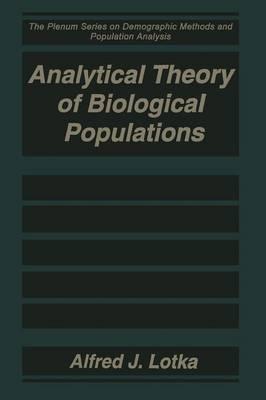
OverviewIn the 50 years that have passed since Alfred Latka's death in 1949 his position as the father of mathematical demography has been secure. With his first demographic papers in 1907 and 1911 (the latter co authored with F. R. Sharpe) he laid the foundations for stable population theory, and over the next decades both largely completed it and found convenient mathematical approximations that gave it practical applica tions. Since his time, the field has moved in several directions he did not foresee, but in the main it is still his. Despite Latka's stature, however, the reader still needs to hunt through the old journals to locate his principal works. As yet no exten sive collections of his papers are in print, and for his part he never as sembled his contributions into a single volume in English. He did so in French, in the two part Theorie Analytique des Associations Biologiques (1934, 1939). Drawing on his Elements of Physical Biology (1925) and most of his mathematical papers, Latka offered French readers insights into his biological thought and a concise and mathematically accessible summary of what he called recent contributions in demographic analy sis. We would be accurate in also calling it Latka's contributions in demographic analysis. Full Product DetailsAuthor: Alfred J. Lotka , David P. Smith , Hélène RossertPublisher: Springer-Verlag New York Inc. Imprint: Springer-Verlag New York Inc. Edition: Softcover reprint of the original 1st ed. 1998 Dimensions: Width: 15.20cm , Height: 1.40cm , Length: 22.90cm Weight: 0.379kg ISBN: 9781475791785ISBN 10: 147579178 Pages: 220 Publication Date: 01 July 2013 Audience: Professional and scholarly , Professional & Vocational Format: Paperback Publisher's Status: Active Availability: Manufactured on demand We will order this item for you from a manufactured on demand supplier. Table of Contents1: Principles.- 1. Untitled [On Evolution in Organic and Inorganic Systems].- 2. Untitled [On the Direction of Time].- 3. Untitled [On Energetics and Uncertainty].- 4. Biological Stoichiometry.- 2: Demographic Analysis with Specific Application to the Human Species.- 1. Introduction.- 2. Relations Involving Mortality and Births.- 3. Relations Involving Fertility.- 4. The Progeny of a Population Element.- 5. Indices and Measures of Natural Increase.- 6. Relations Involving Fertility by Birth Order.- 7. Relations Involving the Survival Functions of Two Individuals.- 8. Extinction of a Line of Descent.- 9. Conclusion.- Author Index.ReviewsAuthor InformationTab Content 6Author Website:Countries AvailableAll regions |
||||