An Unmanned Mission to Mars with Sample Collection and In-Situ Resource Utilization

Author:   National Aeronaut Administration (Nasa)
Publisher:   Createspace Independent Publishing Platform
ISBN:  

9781722230586


Pages:   98
Publication Date:   06 July 2018
Format:   Paperback
Availability:   Available To Order   Availability explained
We have confirmation that this item is in stock with the supplier. It will be ordered in for you and dispatched immediately.

Our Price $65.97 Quantity:  
Add to Cart

Share |

An Unmanned Mission to Mars with Sample Collection and In-Situ Resource Utilization


Overview

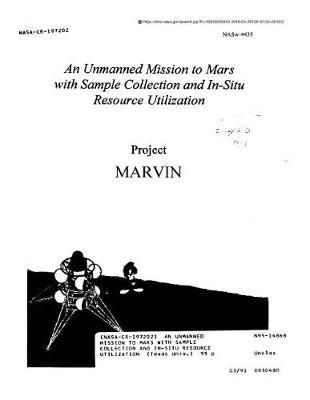
The design for the Mars Analysis and Return Vehicle with In-Situ Resource Utilization (MARVIN) project is outlined. The MARVIN mission is designed to collect samples of the Martian environment; to produce fuel from local Martian resources; and to use the fuel produced to return the samples to earth. It uses only existing technologies. Exploratory Technologies' mission-design efforts have focused on methods of orbit determination, sample collection, fuel production, power, communications, control, and structural design. Lambert Targeting provided Delta-V's, launch dates, and travel times. The landing site is the Tharsis Plateau, to the southeast of Olympus Mons, chosen for its substantial scientific value. Samples of soil, dust, and atmosphere are collected with lander-based collection devices: the soil sample, with a robotic arm similar to those used in the Viking missions; the atmospheric sample, from a bleed line to the compressor in the fuel-production facility; a dust sample, from the dust-collection container in the fuel-production facility; and a redundant dust sample, with a with a passive filter system, which relies upon neither a power source nor other collection methods. The sample-return capsule (SRC) houses these samples, which are triply contained to prevent contamination. Proven technology can be used to produce methane and oxygen for fuel with relative ease at the landing site: the Sabatier reactor produces methane and water by combining carbon dioxide and hydrogen (brought from earth); the Reverse Water-Gas Shift unit combines carbon dioxide and hydrogen to form carbon monoxide and water; a water-electrolysis unit splits the water into hydrogen and oxygen. The Mars-lander vehicle (MLV) transports the equipment from earth to Mars. The Mars-ascent vehicle (MAV) contains the SRC and the engine, which is the same for both the MLV and the MAV. All equipment that is unnecessary for the Mars-Earth trajectory remains on Mars. This report presents detailed si...

Full Product Details

Author:   National Aeronaut Administration (Nasa)
Publisher:   Createspace Independent Publishing Platform
Imprint:   Createspace Independent Publishing Platform
Dimensions:   Width: 21.60cm , Height: 0.50cm , Length: 27.90cm
Weight:   0.249kg
ISBN:  

9781722230586


ISBN 10:   1722230584
Pages:   98
Publication Date:   06 July 2018
Audience:   General/trade ,  General
Format:   Paperback
Publisher's Status:   Active
Availability:   Available To Order   Availability explained
We have confirmation that this item is in stock with the supplier. It will be ordered in for you and dispatched immediately.

Table of Contents

Reviews

Author Information

Tab Content 6

Author Website:  

Countries Available

All regions
Latest Reading Guide

April RG 26_2


Shopping Cart
Your cart is empty
Shopping cart
Mailing List