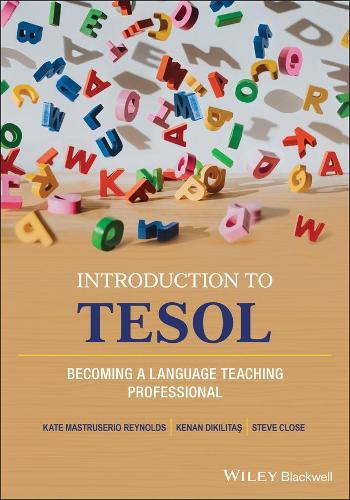
Full Product Details
Author: Kate Mastruserio Reynolds (Central Washington University, USA) ,
Kenan Dikilitas (University of Stavanger, Norway) ,
Steve Close (Big Bend Community College, USA)
Publisher: John Wiley and Sons Ltd
Imprint: Wiley-Blackwell
Dimensions:
Width: 17.80cm
, Height: 2.80cm
, Length: 25.20cm
Weight: 0.862kg
ISBN: 9781119632696
ISBN 10: 1119632692
Pages: 432
Publication Date: 19 October 2021
Audience:
Professional and scholarly
,
Professional & Vocational
Format: Paperback
Publisher's Status: Active
Availability: Available To Order

We have confirmation that this item is in stock with the supplier. It will be ordered in for you and dispatched immediately.
Reviews
The book is well-written and engaging, and one can easily imagine that first-year university students would find the manuscript to be refreshingly approachable compared to the dry, theoretically focused tomes which are so common in our field. - LINGUIST List 33.2059, June 2022 It will be a useful study and reference material for beginning educators hoping to gain a comprehensive overview of TESOL, as well as experienced educators who would like to refresh their perspectives and keep themselves updated on new knowledge and developments. - System, Volume 108, August 2022, 102859
“The book is well-written and engaging, and one can easily imagine that first-year university students would find the manuscript to be refreshingly approachable compared to the dry, theoretically focused tomes which are so common in our field.” - LINGUIST List 33.2059, June 2022 “It will be a useful study and reference material for beginning educators hoping to gain a comprehensive overview of TESOL, as well as experienced educators who would like to refresh their perspectives and keep themselves updated on new knowledge and developments.” – System, Volume 108, August 2022, 102859
The book is well-written and engaging, and one can easily imagine that first-year university students would find the manuscript to be refreshingly approachable compared to the dry, theoretically focused tomes which are so common in our field. - LINGUIST List 33.2059, June 2022
Author Information
Kate Mastruserio Reynolds is Professor of TESOL and Literacy at Central Washington University, USA. She has been in the field of TESOL since 1996 and has authored and edited numerous publications. Most recently, she was Associate Editor for the vocabulary volume of The TESOL Encyclopedia of English Language Teaching. Kenan Dikilitaº is Professor of University Pedagogy at University of Stavanger, Norway. His research interests include TESOL teacher development, action research, and bilingual education in monolingual contexts. He has co-authored various monographs and edited books, and published journal articles on these topics. Steve Close teaches English Literature, Composition, and Communications at Big Bend Community College, USA. He has taught university students in Ukraine and Uzbekistan. His research interests include vernacular English as a tool in the teaching of writing and multicultural studies.