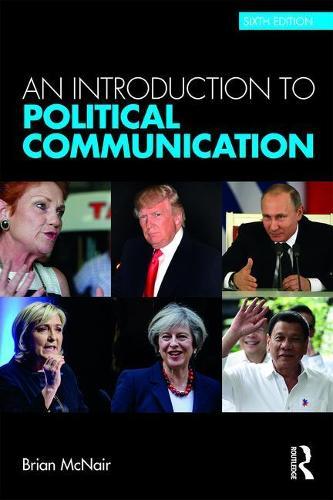
Full Product Details
Author: Brian McNair
Publisher: Taylor & Francis Ltd
Imprint: Routledge
Edition: 6th edition
Volume: 5
Weight: 0.380kg
ISBN: 9780415739429
ISBN 10: 041573942
Pages: 252
Publication Date: 27 June 2017
Audience:
College/higher education
,
Postgraduate, Research & Scholarly
,
Undergraduate
Format: Paperback
Publisher's Status: Active
Availability: In Print

This item will be ordered in for you from one of our suppliers. Upon receipt, we will promptly dispatch it out to you. For in store availability, please contact us.
Reviews
• Later chapters need to be updated, but the earlier more theoretical chapters are still work well • Much more on new and social media/internet and politics – a proper overhaul is needed on this for this edition • More international examples – examples from Asia and Latin America will be particularly useful for US students. Australian examples could also be interesting and the Arab Spring uprisings would be another obvious example to include • Updates on the major elections in US and UK • More pedagogical features and perhaps a companion website to include glossary questions, annotated course notes, links to courses etc. ‘To varying degrees, chapters 4-9 all require some updates, if only to the examples cited […] More generally, whether within the existing structure or via entirely new chapters, there is a strong case for the more extensive discussion of ‘political communication in the digital era’, including the use of Twitter/Facebook etc. by the main political parties and the use of the internet by citizens, sometimes to undermine the political messages put out by political actors […] the key advantage of this text is its accessible writing style – students frequently comment that McNair’s book provides by far the most easy to read introduction to the subject.’ – Dr Paul Smith, Senior Lecturer in Media & Communication, De Montfort University, UK ‘The obvious gap would appear to be the Internet, beyond that coverage of political communication within recent contexts is important in this update. I would expect to see detail on the Obama elections and presidential terms, the Arab Spring and subsequent elections […] It is very important for students to have debates around current examples they can engage with […]McNair’s book is the most important and widely read text book in the field, its value is the critical and extensive coverage and maintaining this while updating the material for the second decade of the 21st Century is key to this being as successful as previous editions […]Students tend to prefer accessible and online content, whether this needs to be built in is questionable given that there is a lot of material online anyway.’ – Darren Lilleker, Lecturer (Director of the Centre for Public Communication Research), Bournemouth University, UK ‘This book is excellent. However more aspects on political communication from Asian perspective need to be added […]It will be very helpful if this book included with student resources such as case studies, essay questions and multiple choice question.’ - Santhidran Sinnappan, Assistant Professor, General Studies, Faculty of Creative Industries, Universiti Tunku Abdul Rahman, Malaysia ‘On the whole well developed and organized. Would like to see an opening chapter on the development of politics from a philosophical and historical context […] Would like to see the chapter 9 address also Asian and Latin American countries. It is West oriented.’ – Basilio Monteiro, Assistant Professor, Division of Mass Communication, Journalism, TV and Film , St. John’s University, USA
- Later chapters need to be updated, but the earlier more theoretical chapters are still work well - Much more on new and social media/internet and politics - a proper overhaul is needed on this for this edition - More international examples - examples from Asia and Latin America will be particularly useful for US students. Australian examples could also be interesting and the Arab Spring uprisings would be another obvious example to include - Updates on the major elections in US and UK - More pedagogical features and perhaps a companion website to include glossary questions, annotated course notes, links to courses etc. 'To varying degrees, chapters 4-9 all require some updates, if only to the examples cited [...] More generally, whether within the existing structure or via entirely new chapters, there is a strong case for the more extensive discussion of 'political communication in the digital era', including the use of Twitter/Facebook etc. by the main political parties and the use of the internet by citizens, sometimes to undermine the political messages put out by political actors [...] the key advantage of this text is its accessible writing style - students frequently comment that McNair's book provides by far the most easy to read introduction to the subject.' - Dr Paul Smith, Senior Lecturer in Media & Communication, De Montfort University, UK 'The obvious gap would appear to be the Internet, beyond that coverage of political communication within recent contexts is important in this update. I would expect to see detail on the Obama elections and presidential terms, the Arab Spring and subsequent elections [...] It is very important for students to have debates around current examples they can engage with [...]McNair's book is the most important and widely read text book in the field, its value is the critical and extensive coverage and maintaining this while updating the material for the second decade of the 21st Century is key to this being as successful as previous editions [...]Students tend to prefer accessible and online content, whether this needs to be built in is questionable given that there is a lot of material online anyway.' - Darren Lilleker, Lecturer (Director of the Centre for Public Communication Research), Bournemouth University, UK 'This book is excellent. However more aspects on political communication from Asian perspective need to be added [...]It will be very helpful if this book included with student resources such as case studies, essay questions and multiple choice question.' - Santhidran Sinnappan, Assistant Professor, General Studies, Faculty of Creative Industries, Universiti Tunku Abdul Rahman, Malaysia 'On the whole well developed and organized. Would like to see an opening chapter on the development of politics from a philosophical and historical context [...] Would like to see the chapter 9 address also Asian and Latin American countries. It is West oriented.' - Basilio Monteiro, Assistant Professor, Division of Mass Communication, Journalism, TV and Film, St. John's University, USA
Author Information
Brian McNair is Professor of Journalism, Media and Communication at Queensland University of Technology. He is the author of fourteen books, including Communication and Political Crisis (2016), Cultural Chaos (2006), Journalists in Film (2010) and Politics, Media and Democracy in Australia (with Flew et al., 2017).