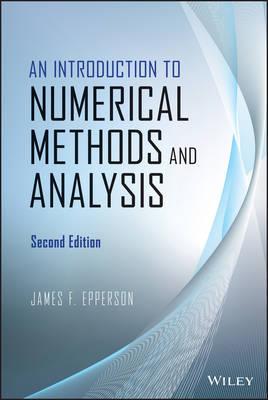
An Introduction to Numerical Methods and Analysis

Author:   James F. Epperson (American Mathematical Society)
Publisher:   John Wiley & Sons Inc
Edition:   2nd Revised edition
ISBN:  

9781118730966


Pages:   614
Publication Date:   27 January 2014
Format:   Electronic book text
Availability:   Available To Order   Availability explained
We have confirmation that this item is in stock with the supplier. It will be ordered in for you and dispatched immediately.

Our Price $351.12 Quantity:  
Add to Cart

Share |

An Introduction to Numerical Methods and Analysis


Overview

Praise for the First Edition . . . outstandingly appealing with regard to its style, contents, considerations of requirements of practice, choice ofexamples, and exercises. --Zentralblatt MATH . . . carefully structured with many detailed workedexamples. --The Mathematical Gazette The Second Edition of the highly regarded An Introductionto Numerical Methods and Analysis provides a fully revisedguide to numerical approximation. The book continues to beaccessible and expertly guides readers through the many availabletechniques of numerical methods and analysis. An Introduction to Numerical Methods and Analysis, SecondEdition reflects the latest trends in the field, includes newmaterial and revised exercises, and offers a unique emphasis onapplications. The author clearly explains how to both construct andevaluate approximations for accuracy and performance, which are keyskills in a variety of fields. A wide range of higher-level methodsand solutions, including new topics such as the roots ofpolynomials, spectral collocation, finite element ideas, andClenshaw-Curtis quadrature, are presented from an introductoryperspective, and the Second Edition also features: Chapters and sections that begin with basic, elementarymaterial followed by gradual coverage of more advancedmaterial Exercises ranging from simple hand computations to challengingderivations and minor proofs to programming exercises Widespread exposure and utilization of MATLAB An appendix that contains proofs of various theorems and othermaterial The book is an ideal textbook for students in advancedundergraduate mathematics and engineering courses who areinterested in gaining an understanding of numerical methods andnumerical analysis.

Full Product Details

Author:   James F. Epperson (American Mathematical Society)
Publisher:   John Wiley & Sons Inc
Imprint:   John Wiley & Sons Inc
Edition:   2nd Revised edition
ISBN:  

9781118730966


ISBN 10:   1118730968
Pages:   614
Publication Date:   27 January 2014
Audience:   Professional and scholarly ,  Professional & Vocational
Format:   Electronic book text
Publisher's Status:   Active
Availability:   Available To Order   Availability explained
We have confirmation that this item is in stock with the supplier. It will be ordered in for you and dispatched immediately.

Table of Contents

Preface xiii 1 Introductory Concepts and Calculus Review 1 1.1 Basic Tools of Calculus 2 1.2 Error, Approximate Equality, and Asymptotic Order Notation14 1.3 A Primer on Computer Arithmetic 20 1.4 A Word on Computer Languages and Software 29 1.5 Simple Approximations 30 1.6 Application: Approximating the Natural Logarithm 35 1.7 A Brief History of Computing 37 References 41 2 A Survey of Simple Methods and Tools 43 2.1 Horner's Rule and Nested Multiplication 43 2.2 Difference Approximations to the Derivative 48 2.3 Application: Euler's Method for Initial Value Problems56 2.4 Linear Interpolation 62 2.5 Application-The Trapezoid Rule 68 2.6 Solution of Tridiagonal Linear Systems 78 2.7 Application: Simple TwoPoint Boundary Value Problems 85 3 RootFinding 91 3.1 The Bisection Method 92 3.2 Newton's Method: Derivation and Examples 99 3.3 How to Stop Newton's Method 105 3.4 Application: Division Using Newton's Method 108 3.5 The Newton Error Formula 112 3.6 Newton's Method: Theory and Convergence 117 3.7 Application: Computation of the Square Root 121 3.8 The Secant Method: Derivation and Examples 124 3.9 Fixed Point Iteration 128 3.10 Roots of Polynomials (Part 1) 138 3.11 Special Topics in Rootfinding Methods 145 3.12 Very Highorder Methods and the Efficiency Index 167 3.13 Literature and Software Discussion 170 References 173 4 Interpolation and Approximation 175 4.1 Lagrange Interpolation 175 4.2 Newton Interpolation and Divided Differences 181 4.3 Interpolation Error 191 4.4 Application: Muller's Method and Inverse QuadraticInterpolation 196 4.5 Application: More Approximations to the Derivative 199 4.6 Hermite Interpolation 202 4.7 Piecewise Polynomial Interpolation 206 4.8 An Introduction to Splines 214 4.9 Application: Solution of Boundary Value Problems 227 4.10 Tension Splines 232 4.11 Least Squares Concepts in Approximation 237 4.12 Advanced Topics in Interpolation Error 254 4.13 Literature and Software Discussion 265 References 267 5 Numerical Integration 269 5.1 A Review of the Definite Integral 270 5.2 Improving the Trapezoid Rule 272 5.3 Simpson's Rule and Degree of Precision 277 5.4 The Midpoint Rule 289 5.5 Application: Stirling's Formula 292 5.6 Gaussian Quadrature 294 5.7 Extrapolation Methods 306 5.8 Special Topics in Numerical Integration 313 5.9 Literature and Software Discussion 334 References 335 6 Numerical Methods for Ordinary Differential Equations337 6.1 The Initial Value Problem-Background 338 6.2 Euler's Method 343 6.3 Analysis of Euler's Method 347 6.4 Variants of Euler's Method 350 6.5 Single Step Methods-Runge-Kutta 367 6.6 Multistep Methods 374 6.7 Stability Issues 380 6.8 Application to Systems of Equations 386 6.9 Adaptive Solvers 394 6.10 Boundary Value Problems 407 6.11 Literature and Software Discussion 422 References 425 7 Numerical Methods for the Solution of Systems of Equations427 7.1 Linear Algebra Review 428 7.2 Linear Systems and Gaussian Elimination 430 7.3 Operation Counts 437 7.4 The LU Factorization 440 7.5 Perturbation, Conditioning, and Stability 451 7.6 SPD Matrices and the Cholesky Decomposition 467 7.7 Iterative Methods for Linear Systems-A Brief Survey470 7.8 Nonlinear Systems: Newton's Method and Related Ideas479 7.9 Application: Numerical Solution of Nonlinear Boundary ValueProblems 484 7.10 Literature and Software Discussion 487 References 489 8 Approximate Solution of the Algebraic Eigenvalue Problem491 8.1 Eigenvalue Review 491 8.2 Reduction to Hessenberg Form 498 8.3 Power Methods 503 8.4 An Overview of the QR Iteration 521 8.5 Application: Roots of Polynomials, II 530 8.6 Literature and Software Discussion 531 References 533 9 A Survey of Numerical Methods for Partial DifferentialEquations 535 9.1 Difference Methods for the Diffusion Equation 535 9.2 Finite Element Methods for the Diffusion Equation 550 9.3 Difference Methods for Poisson Equations 553 9.4 Literature and Software Discussion 567 References 569 10 An Introduction to Spectral Methods 571 10.1 Spectral Methods for TwoPoint Boundary Value Problems572 10.2 Spectral Methods for TimeDependent Problems 584 10.3 ClenshawCurtis Quadrature 593 10.4 Literature and Software Discussion 596 References 597 Appendix A: Proofs of Selected Theorems, and Other AdditionalMaterial 599 A.1 Proofs of the Interpolation Error Theorems 599 A.2 Proof of the Stability Result for ODEs 601 A.3 Stiff Systems of Differential Equations and Eigenvalues602 A.4 The Matrix Perturbation Theorem 604 Index 605

Reviews

-This is an excellent textbook for a numerical analysis course although it will be difficult to cover all the material in just one course. Because the text is so complete, it could as well be used for self-study.- (American Mathematical Society, 1 August 2014) This is an excellent textbook for a numerical analysis course although it will be difficult to cover all the material in just one course. Because the text is so complete, it could as well be used for self-study. (American Mathematical Society, 1 August 2014) This is an excellent textbook for a numerical analysis course although it will be difficult to cover all the material in just one course. Because the text is so complete, it could as well be used for self-study. ( American Mathematical Society, 1 August 2014)


Author Information

JAMES F. EPPERSON, PhD, is Associate Editor of Mathematical Reviews for the American Mathematical Society. He was previously associate professor in the Department of Mathematics at The University of Alabama in Huntsville and assistant professor at the University of Georgia in Athens. He earned his doctorate at Carnegie Mellon University in Pittsburgh and his undergraduate degree from the College of Engineering at the University of Michigan, Ann Arbor.

Tab Content 6

Author Website:  

Countries Available

All regions
Latest Reading Guide

NOV RG 20252


Shopping Cart
Your cart is empty
Shopping cart
Mailing List