Overview
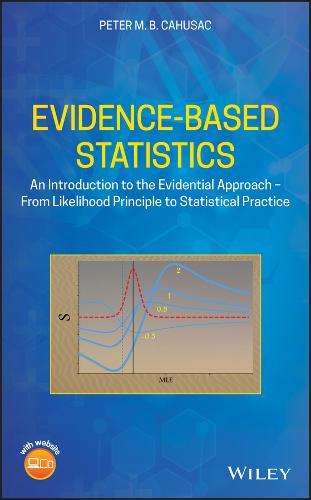
Evidence-Based Statistics: An Introduction to the Evidential Approach – from Likelihood Principle to Statistical Practice provides readers with a comprehensive and thorough guide to the evidential approach in statistics. The approach uses likelihood ratios, rather than the probabilities used by other statistical inference approaches. The evidential approach is conceptually easier to grasp, and the calculations more straightforward to perform. This book explains how to express data in terms of the strength of statistical evidence for competing hypotheses. The evidential approach is currently underused, despite its mathematical precision and statistical validity. Evidence-Based Statistics is an accessible and practical text filled with examples, illustrations and exercises. Additionally, the companion website complements and expands on the information contained in the book. While the evidential approach is unlikely to replace probability-based methods of statistical inference, it provides a useful addition to any statistician’s ""bag of tricks."" In this book: It explains how to calculate statistical evidence for commonly used analyses, in a step-by-step fashion Analyses include: t tests, ANOVA (one-way, factorial, between- and within-participants, mixed), categorical analyses (binomial, Poisson, McNemar, rate ratio, odds ratio, data that's 'too good to be true', multi-way tables), correlation, regression and nonparametric analyses (one sample, related samples, independent samples, multiple independent samples, permutation and bootstraps) Equations are given for all analyses, and R statistical code provided for many of the analyses Sample size calculations for evidential probabilities of misleading and weak evidence are explained Useful techniques, like Matthews's critical prior interval, Goodman's Bayes factor, and Armitage's stopping rule are described Recommended for undergraduate and graduate students in any field that relies heavily on statistical analysis, as well as active researchers and professionals in those fields, Evidence-Based Statistics: An Introduction to the Evidential Approach – from Likelihood Principle to Statistical Practice belongs on the bookshelf of anyone who wants to amplify and empower their approach to statistical analysis.
Full Product Details
Author: Peter M. B. Cahusac
Publisher: John Wiley & Sons Inc
Imprint: John Wiley & Sons Inc
Dimensions:
Width: 1.00cm
, Height: 1.00cm
, Length: 1.00cm
Weight: 0.454kg
ISBN: 9781119549802
ISBN 10: 1119549809
Pages: 256
Publication Date: 06 October 2020
Audience:
Professional and scholarly
,
Professional & Vocational
Format: Hardback
Publisher's Status: Active
Availability: Out of stock

The supplier is temporarily out of stock of this item. It will be ordered for you on backorder and shipped when it becomes available.
Reviews
The likelihood approach is a distinct one that spans between the Bayesian and frequentist, but there has not been a good textbook treatment that could be used, say, by Psychology final year Bachelors' students or established researchers. Until now, that is - Cahusac's text is very clear, very readable, and shows exactly how to apply the likelihood approach to ANOVA and regression, and to categorical and rank data, using R. - Zoltan Dienes, The Journal of the Royal Statistical Society, Series A (Statistics in Society) 185:1 (2022) This book is so amazing and easy to comprehend, you will simply love it. I am sure that this book is going to be among the top-rated books in the field of biostatistics. - Professor Dileep K. Rohra, MD, PhD (Chair of Department of Pharmacology, College of Medicine, Alfaisal University) (2021) This superbly written book explains complex biostatistical concepts in a simpler format, making it much easier to comprehend and apply in diverse specialized areas. - Dr. Fazal Hussain, MD, MPH (2021)
“The likelihood approach is a distinct one that spans between the Bayesian and frequentist, but there has not been a good textbook treatment that could be used, say, by Psychology final year Bachelors’ students or established researchers. Until now, that is – Cahusac’s text is very clear, very readable, and shows exactly how to apply the likelihood approach to ANOVA and regression, and to categorical and rank data, using R.” - Zoltan Dienes, The Journal of the Royal Statistical Society, Series A (Statistics in Society) 185:1 (2022) “This book is so amazing and easy to comprehend, you will simply love it. I am sure that this book is going to be among the top-rated books in the field of biostatistics.” - Professor Dileep K. Rohra, MD, PhD (Chair of Department of Pharmacology, College of Medicine, Alfaisal University) (2021) “This superbly written book explains complex biostatistical concepts in a simpler format, making it much easier to comprehend and apply in diverse specialized areas.” - Dr. Fazal Hussain, MD, MPH (2021)
Author Information
PETER M.B. CAHUSAC, PHD, received his doctorate in neuropharmacology from the Medical School Bristol University in 1984. He completed post-doctoral studies at Oxford University where he obtained an MSc in Applied Statistics in 1992. He is a member of the British Pharmacological Society, and Fellow of the Physiological (UK) and the Royal Statistical Societies. He is currently Associate Professor in Biostatistics and Pharmacology at Alfaisal University in Riyadh, Saudi Arabia.