Overview
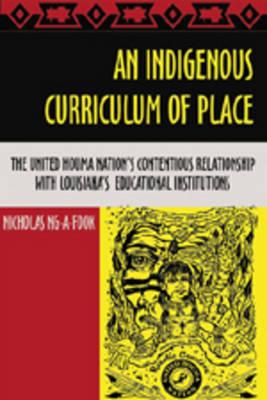
The longest desegregation lawsuit in American history, involving Louisiana's political, judicial and educational institutions, was recently settled. Like many African-American communities in the south, members of the United Houma Nation did not have access to White systems of public education, or to African-American schools, until the mid-1960s. This book illustrates how the Louisiana state apparatus historically dictated educational exclusion through its infamous Jim Crow policies of racial segregation. Utilizing a combination of ethnography, historiography, and oral history methods, its research narratives are specifically concerned with the life histories of United Houma Nation elders who experienced firsthand the complexities and difficulties of institutional racism. An Indigenous Curriculum of Place is essential reading for curriculum scholars, teachers, and community leaders. The narratives in this book not only have the potential to teach us about alternative ways of knowing, but also to understand the limits of our colonized worldviews.
Full Product Details
Author: Nicholas Ng-A-Fook ,
Prof William F Pinar
Publisher: Peter Lang Publishing Inc
Imprint: Peter Lang Publishing Inc
Edition: 2nd Revised edition
Volume: 25
Weight: 0.580kg
ISBN: 9781433100147
ISBN 10: 1433100142
Pages: 232
Publication Date: 23 August 2007
Audience:
Professional and scholarly
,
Professional & Vocational
Format: Hardback
Publisher's Status: Active
Availability: Awaiting stock

The supplier is currently out of stock of this item. It will be ordered for you and placed on backorder. Once it does come back in stock, we will ship it out for you.
Reviews
The United Houma Nation of Louisiana was doubly disadvantaged. As Indians, they were denied access both to schools intended for white children and to those set aside for African-Americans. Working closely with elders and others, Nicholas Ng-A-Fook tells their story of educational exclusion and...their [subsequent appropriation of] a colonial institution for their own purposes. Ng-A-Fook is at his best in sensitively and respectively evoking the Houma perspective, using conversations with informants to open up a remarkable window into a way of life and worldview. An Indigenous Curriculum of Place provides an incisive, highly readable critique of the racial segregation long associated with the American South from an indigenous perspective while also holding out hope for equitable schooling grounded in relevant curriculum. (Jean Barman, Professor Emeritus at the University of British Columbia, and Fellow of the Royal Society of Canada) Years ago when Nicholas Ng-A-Fook first came to the Houma community he asked to hear our stories. 'What stories do you want to hear?' we asked, and his answer was, 'what stories do you want to tell?' Thus began a relationship between an academic and an indigenous people that I believe can be used as a pattern for such relationships. The years he spent learning about us were also years he spent using his talents and abilities to assist the Houma people. Not only does this work document the struggles of the Houma people for educational opportunities, but also provides a testament to the commitment Nicholas Ng-A-Fook has made to the United Houma Nation. (Michael T. Mayheart Dardar, Vice-Principal Chief of United Houma Nation) The rich oral history narratives of the Houma people brought to life in this book reveal how one of Louisiana's oldest indigenous peoples continues to struggle to define themselves against and within colonial ideologies. By situating the Houma within a larger historical, cultural, economic, and political context, this book 'unsettles' the dominant Euro-centric narrative of educational history. Nicholas Ng-A-Fook's compelling portrait of the Houma brings out of the shadows stories of resistance, accommodation, and resilience. Woven throughout is the author's own self-reflexive gaze to unpack the power relations embedded within research. Interweaving ethnographic and oral history methodologies, historical research, intensive field work, and postcolonial theory, this is a much-needed contribution to the fields of curriculum studies, cultural studies, history of education, and social foundations, as well as qualitative research. (Petra Munro Hendry, St. Bernard Endowed Professor, Louisiana State University)
The rich oral history narratives of the Houma people brought to life in this book reveal how one of Louisiana's oldest indigenous peoples continues to struggle to define themselves against and within colonial ideologies. By situating the Houma within a larger historical, cultural, economic, and political context, this book 'unsettles' the dominant Eurocentric narrative of educational history. Nicholas Ng-A-Fook's compelling portrait of the Houma brings out of the shadows stories of resistance, accommodation, and resilience. Woven throughout is the author's own self-reflexive gaze to unpack the power relations embedded within research. Interweaving ethnographic and oral history methodologies, historical research, intensive field work, and postcolonial theory, this is a much-needed contribution to the fields of curriculum studies, cultural studies, history of education, and social foundations, as well as qualitative research.
Author Information
The Author: Nicholas Ng-A-Fook received his doctorate in curriculum and instruction at Louisiana State University, after which he began working with the United Houma Nation. He is currently Assistant Professor of Curriculum Theory at the University of Ottawa.