|
|
|||
|
||||
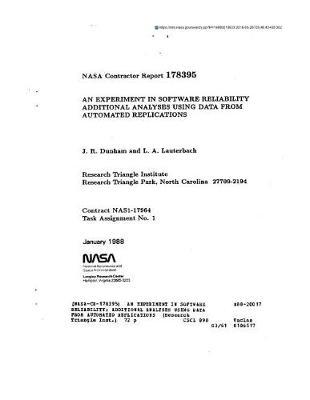
OverviewA study undertaken to collect software error data of laboratory quality for use in the development of credible methods for predicting the reliability of software used in life-critical applications is summarized. The software error data reported were acquired through automated repetitive run testing of three independent implementations of a launch interceptor condition module of a radar tracking problem. The results are based on 100 test applications to accumulate a sufficient sample size for error rate estimation. The data collected is used to confirm the results of two Boeing studies reported in NASA-CR-165836 Software Reliability: Repetitive Run Experimentation and Modeling, and NASA-CR-172378 Software Reliability: Additional Investigations into Modeling With Replicated Experiments, respectively. That is, the results confirm the log-linear pattern of software error rates and reject the hypothesis of equal error rates per individual fault. This rejection casts doubt on the assumption that the program's failure rate is a constant multiple of the number of residual bugs; an assumption which underlies some of the current models of software reliability. data raises new questions concerning the phenomenon of interacting faults. Dunham, Janet R. and Lauterbach, Linda A. Unspecified Center... Full Product DetailsAuthor: National Aeronaut Administration (Nasa)Publisher: Createspace Independent Publishing Platform Imprint: Createspace Independent Publishing Platform Dimensions: Width: 21.60cm , Height: 0.40cm , Length: 27.90cm Weight: 0.195kg ISBN: 9781722181925ISBN 10: 1722181923 Pages: 74 Publication Date: 06 July 2018 Audience: General/trade , General Format: Paperback Publisher's Status: Active Availability: Available To Order We have confirmation that this item is in stock with the supplier. It will be ordered in for you and dispatched immediately. Table of ContentsReviewsAuthor InformationTab Content 6Author Website:Countries AvailableAll regions |
||||