Overview
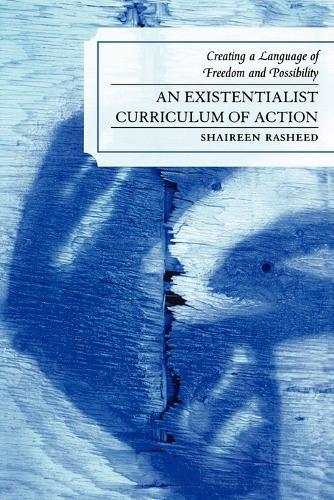
This book contextualizes Maxine Greene's educational pedagogy within an existentialist tradition. By drawing on the works of Jean-Paul Sartre, Paulo Freire, and Merleau-Ponty, Professor Rasheed analyzes how Greene's work represents an advance in existentialist discourse via her interpretation of concepts, such as choice, freedom, and possibility within an educational setting. The aim of this work is to create an ""existentialist curriculum of action"" that is grounded in a vision of leadership. Educators, teachers, students, policy makers, and curriculum theorists can implement this critique as part of an emancipatory and transformative pedagogy. By developing an ethical language of existential possibility, Professor Rasheed creates a space where discourse explores the various intersections of gender, race, class, ethnicity, religion and sexual orientation, which coexist within a participatory definition of democracy.
Full Product Details
Author: Shaireen Rasheed
Publisher: University Press of America
Imprint: University Press of America
Dimensions:
Width: 14.80cm
, Height: 0.90cm
, Length: 22.80cm
Weight: 0.145kg
ISBN: 9780761835912
ISBN 10: 0761835911
Pages: 90
Publication Date: 20 December 2006
Audience:
General/trade
,
General
Format: Paperback
Publisher's Status: Active
Availability: In Print

This item will be ordered in for you from one of our suppliers. Upon receipt, we will promptly dispatch it out to you. For in store availability, please contact us.
Reviews
[Rasheed]... provide[s] a conceptual and philosophical framework for looking behind the screen of the teleological givens within instrumental curriculum and to explore the possibilities of a curriculum of action... This framework, which is an existentialist perspective, implores educators to look past the givens associated with neoliberalist concepts of education that are said to produce degrees of passive compliance to the possibilities associated with a curriculum which fosters critical spirit? a spiritwhich, once deployed, seeks possibility, hope and change. If you are interested in freedom and emancipation, and how it relates to curriculum within our teaching institutions, Rasheed provides an easy to read, yet conceptually grounded journey...This book is particularly useful for beginning educators in the sense that it will prompt them to examine the platform upon which they make their day-to-day curriculum and teaching decisions. It is also useful for experienced educators whose re
Shaireen Rasheed's engaging book carries forward the existentialist tradition in educational thinking into our new century. Proceeding from the work of Maxine Greene, the leading representative of this tradition, Rasheed introduces us to this work via an examination of its philosophical roots and its affinities with Freire's critical pedagogy. She then extends Greene's thinking into the field of curriculum theory, developing out of its implications a language that emphasizes a curriculum's humanizing possibilities. Anyone interested in how education's humanistic values may be defended with the help of existentialist arguments will be likely to find much of interest in Rasheed's discussion.--Ren V. Arcilla
Author Information
Shaireen Rasheed (Ph.D., Columbia University) is an Associate Professor in Philosophical Foundations of Education at C.W. Post Campus of Long Island University.