Overview
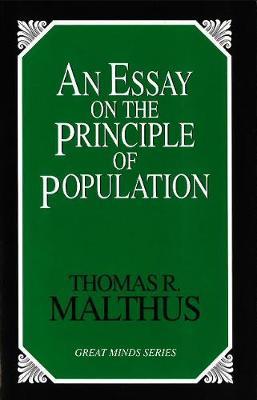
English economist and professor Thomas R Malthus (1766-1834) caused great public controversy among the optimistic positivists of his day when his ""Essay on the Principle of Population"" (1798) showed incontrovertibly that population, when unchecked, tends to increase faster than the availability of subsistence therefore preventive checks on population increase are necessary. Malthus, whose work influenced the research of Charles Darwin, admitted he was pessimistic about the future of humankind. He argued, through mathematical proofs and scientific documentation, that without population control the societal result is overcrowding, disease, war, poverty, and vice.
Full Product Details
Author: Thomas Robert Malthus
Publisher: Prometheus Books
Imprint: Prometheus Books
Dimensions:
Width: 15.20cm
, Height: 1.30cm
, Length: 22.90cm
Weight: 0.454kg
ISBN: 9781573922555
ISBN 10: 1573922552
Pages: 400
Publication Date: 01 March 1999
Audience:
College/higher education
,
Professional and scholarly
,
Undergraduate
,
Postgraduate, Research & Scholarly
Format: Paperback
Publisher's Status: Active
Availability: Out of stock

The supplier is temporarily out of stock of this item. It will be ordered for you on backorder and shipped when it becomes available.
Author Information
THOMAS ROBERT MALTHUS was born in Rookery, Surrey, England, in February 1766. He attended Cambridge Uni-versity, earning a master's degree in 1791. In 1805 he became a professor of history and political economy at the East India Company's college in Haileybury, Hertfordshire, a position he held for the rest of his life. Malthus is most famous for his Essay on the Principle of Population Control (1798), which argues that increases in population will eventually overcome the world's ability to feed itself, resulting in widespread starvation. He based this conclusion on the belief that populations grow at a geo-metric rate, whereas the food supply increases at an arith-metic one. A pessimist who viewed the notion of human per-fectibility as foolishness, Malthus saw famine, disease, and war as necessary checks on population growth. Later he believed that ""moral restraint"" (delayed marriage and sexual abstinence prior to it) could also help curb the problem. Malthus's works on economics include An Inquiry into Nature and the Progress of Rent (1815) and Principles of Polit-ical Economy (1820). Many ideas contained in these works anticipate the thinking of economist John Maynard Keynes, who lived a century later. Malthus's pessimistic assessment of life as a ""struggle for existence"" also influ-enced Charles Darwin's evolutionary mechanism of natural selection, or ""survival of the fittest."" Thomas Malthus died at Haileybury on December 23, 1834.