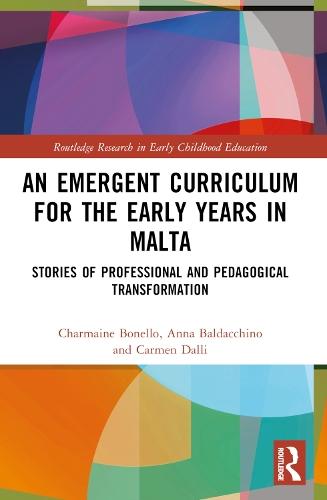
Full Product Details
Author: Charmaine Bonello (University of Malta, Malta) ,
Anna Baldacchino (University of Malta, Malta) ,
Carmen Dalli (Victoria University of Wellington, New Zealand)
Publisher: Taylor & Francis Ltd
Imprint: Routledge
ISBN: 9781032664743
ISBN 10: 1032664746
Pages: 204
Publication Date: 22 May 2026
Audience:
College/higher education
,
Professional and scholarly
,
Tertiary & Higher Education
,
Professional & Vocational
Format: Paperback
Publisher's Status: Forthcoming
Availability: Not yet available

This item is yet to be released. You can pre-order this item and we will dispatch it to you upon its release.
Reviews
'Addressing an urgent need in the Maltese education sector, this book showcases how even the youngest learners (0-7 years) can actively contribute to shaping their educational experiences. Through seven inspiring stories and practical examples, it demonstrates how educators can successfully implement early childhood pedagogies that promote active citizenship from the very foundation of the education system. By maintaining a strong, positive image of young children as capable beings, these educators fostered environments where children's rights are realised and respected in early education. Join the movement towards realising children's rights in early education. An Emergent Curriculum for the Early Years in Malta: Stories of Professional and Pedagogical Transformation is not just a book—it's a call to action for educators to embrace the incredible potential of young learners and transform the educational landscape from the ground up.' Marie Louise Coleiro Preca, President of Eurochild, Former President of Malta 'The meaning and enactment of an emergent and child-centred curriculum are brought to life in this timely book, illustrative of how educators in Malta moved away from a traditional prescribed curriculum framework to centre the voices and experiences of children, explore their interests and ideas and work with parents and community as partners. The seven stories of successful practitioners highlight that educators can forge localised curriculum practices that not only respond to children and impact on learning but also increase their own agency. This is a hopeful book that shows that transformative change is possible, given facilitating conditions. It is an international book with global messages and a valuable antidote to internationally standardised and context free curriculum and assessment approaches.' Professor Linda Mitchell, Waikato University, New Zealand 'This book makes an important and timely contribution, sharing the insightful stories of early years educators who re-imagined and transformed their practice. In addition to the fascinating story of change in the Maltese context, the authors have created an excellent resource that will resonate with educators, leaders and policy makers in any country as they seek to reflect on and refine pedagogy in both ECE and early school settings. Drawing from a clearly articulated academic rationale, the detailed research narratives engage readers with the joys and challenges of taking time to listen to children and create an authentic emergent curriculum.' Professor Sally Peters, University of Waikato, New Zealand 'In an education world that is constantly looking for spaces of hope, seven resources of hope have shared their lived experiences. This is a book that foregrounds multiple curricular and personal stories that converge around education as a possibility; a living testament of how early childhood education can serve child development as well as professional growth. The book’s most powerful message is that transformation is doable even within contexts traditionally marked by prescription and transmission. It is a work that foregrounds educators who are willing to concretise the moral imperative of serving children first. Kudos to the authors who have given us an opportunity to remain hopeful while critically engaging with an educational world that cries for change.' Professor Carmel Borg, University of Malta 'Addressing an urgent need in the Maltese education sector, this book showcases how even the youngest learners (0-7 years) can actively contribute to shaping their educational experiences. Through seven inspiring stories and practical examples, it demonstrates how educators can successfully implement early childhood pedagogies that promote active citizenship from the very foundation of the education system. By maintaining a strong, positive image of young children as capable beings, these educators fostered environments where children's rights are realised and respected in early education. Join the movement towards realising children's rights in early education. An Emergent Curriculum for the Early Years in Malta: Stories of Professional and Pedagogical Transformation is not just a book—it's a call to action for educators to embrace the incredible potential of young learners and transform the educational landscape from the ground up.' Marie Louise Coleiro Preca, President of Eurochild, Former President of Malta 'The meaning and enactment of an emergent and child-centred curriculum are brought to life in this timely book, illustrative of how educators in Malta moved away from a traditional prescribed curriculum framework to centre the voices and experiences of children, explore their interests and ideas and work with parents and community as partners. The seven stories of successful practitioners highlight that educators can forge localised curriculum practices that not only respond to children and impact on learning but also increase their own agency. This is a hopeful book that shows that transformative change is possible, given facilitating conditions. It is an international book with global messages and a valuable antidote to internationally standardised and context free curriculum and assessment approaches.' Professor Linda Mitchell, University of Waikato, New Zealand 'This book makes an important and timely contribution, sharing the insightful stories of early years educators who re-imagined and transformed their practice. In addition to the fascinating story of change in the Maltese context, the authors have created an excellent resource that will resonate with educators, leaders and policy makers in any country as they seek to reflect on and refine pedagogy in both ECE and early school settings. Drawing from a clearly articulated academic rationale, the detailed research narratives engage readers with the joys and challenges of taking time to listen to children and create an authentic emergent curriculum.' Professor Sally Peters, University of Waikato, New Zealand 'In an education world that is constantly looking for spaces of hope, seven resources of hope have shared their lived experiences. This is a book that foregrounds multiple curricular and personal stories that converge around education as a possibility; a living testament of how early childhood education can serve child development as well as professional growth. The book’s most powerful message is that transformation is doable even within contexts traditionally marked by prescription and transmission. It is a work that foregrounds educators who are willing to concretise the moral imperative of serving children first. Kudos to the authors who have given us an opportunity to remain hopeful while critically engaging with an educational world that cries for change.' Professor Carmel Borg, University of Malta
Author Information
Charmaine Bonello is Senior Lecturer in Early Childhood and Primary Education at the University of Malta, Malta. Anna Baldacchino is Lecturer in Early Childhood and Primary Education at the University of Malta, Malta. Carmen Dalli is Professor of Early Childhood Studies and Dean of Education at Te Herenga Waka – Victoria University of Wellington, New Zealand.