Overview
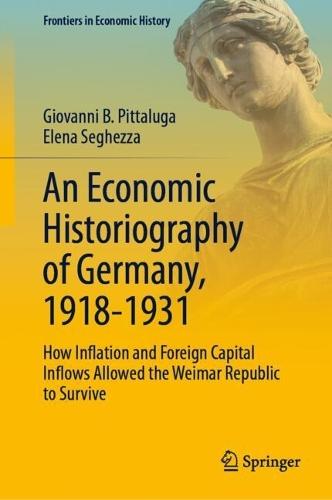
Contrary to existing economic analyses of the Weimar Republic, this book looks beyond the explanations of the individual events that characterized it - in particular hyperinflation, Brüning's fiscal policy, and the 1931 crisis. Instead, it adopts a more unified approach, and thereby sheds light on the underlying causes of these events. The book argues that these individual events were the final result of economic processes and policy choices which had made it possible to mitigate the social and political conflict that would otherwise have undermined the Republic’s existence. Specifically, it postulates that hyperinflation was the result of the ""persistent"" inflation, which had permitted Germany to maintain low unemployment, meet unions' wage demands, and contain left-wing radicalism. Similarly, the banking and currency crisis of 1931 was caused by a sudden stop related to the high level of foreign debt incurred by Germany after the Dawes Plan. Debt which had, however, enabled the country to finance the persistent external deficits resulting from its high domestic demand and large public expenditure incurred in an attempt to avoid social conflict. The book reviews the various models and approaches proposed highlighting their relative strengths and weakness and concludes by providing a unifying common thread which explains how the dramatic economic events which characterized the Weimar Republic were the result of the very economic processes which had contributed to its temporary survival. This book will appeal to students, scholars, economic researchers in general, and more specifically to those interested in economic history, monetary and financial economics, economic policy, political decision making, and political economy, in particular, those seeking a better understanding of the Weimar Republic's economic history.
Full Product Details
Author: Giovanni B. Pittaluga ,
Elena Seghezza
Publisher: Springer International Publishing AG
Imprint: Springer International Publishing AG
Edition: 2024 ed.
ISBN: 9783031703461
ISBN 10: 3031703464
Pages: 261
Publication Date: 10 December 2024
Audience:
Professional and scholarly
,
Professional & Vocational
Format: Hardback
Publisher's Status: Active
Availability: Manufactured on demand

We will order this item for you from a manufactured on demand supplier.
Author Information
Giovanni B. Pittaluga is a Professor Emeritus at the University of Genoa, Italy where he teaches International Monetary Economics. Prior to this, he taught Monetary Economics at the Catholic University of Milan and also at Genoa University. He has worked for the Research Department of the Banca D’Italia and is the author of numerous papers and books on monetary economics. Elena Seghezza is a Full Professor of Economic Policy at the University of Genoa, Italy. She previously worked as an economist in the Department of Economic Affairs and at the Organization for Economic Cooperation and Development (OECD). She holds a Ph.D. in International Economics from the Graduate Institute of International Studies, Geneva, Switzerland and has published numerous articles on political economy, inflation, and international economics.