Overview
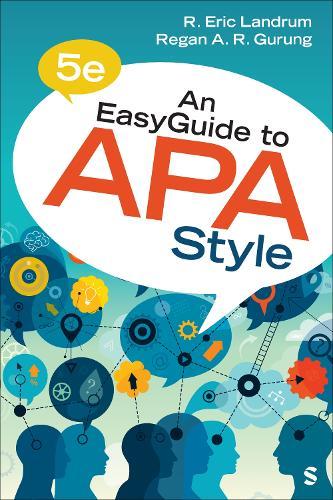
Help students navigate APA style with confidence using An EasyGuide to APA Style, Fifth Edition. Fully updated with content from the Seventh Edition of the Publication Manual of the American Psychological Association, this handy resource helps students apply APA rules accurately and avoid common mistakes. This guide includes real-world examples, an annotated sample student paper, updates on AI citation practices, and more.
Full Product Details
Author: R. Eric Landrum ,
Regan A. R. Gurung
Publisher: SAGE Publications Inc
Imprint: SAGE Publications Inc
Edition: 5th Revised edition
Weight: 0.450kg
ISBN: 9798348811594
Pages: 272
Publication Date: 14 February 2026
Audience:
College/higher education
,
Undergraduate
Format: Spiral bound
Publisher's Status: Forthcoming
Availability: Not yet available

This item is yet to be released. You can pre-order this item and we will dispatch it to you upon its release.
Reviews
A highly engaging, carefully presented overview of APA. Applicable to experts as much as beginners. -- Will Miller * Pre-Revision Review * Overall, I LOVE this book. It′s a little easier to navigate than OWL and is very concise in presentation. -- Stephani Cuddie * Pre-Revision Review * This is a book that helps students become acquainted with APA style in a brief, easy-to-use format. -- Timothy Gunnells * Pre-Revision Review *
Author Information
R. Eric Landrum is a professor and chair in the Department of Psychological Science at Boise State University. He received his PhD in cognitive psychology from Southern Illinois University–Carbondale. He is a research generalist, broadly addressing the improvement of teaching and learning, including the long-term retention of introductory psychology content, skills assessment, improvement of help-seeking behavior, innovations in advising, understanding of student career paths, the psychology workforce, successful graduate school applications, and more. Eric has made more than 425 presentations, written 23 books, and published 85 peer-reviewed journal articles. He has collaborated with more than 300 research assistants and taught more than 18,000 students in 28 years at Boise State. During summer 2008, he led an American Psychological Association (APA) working group at the National Conference for Undergraduate Education in Psychology studying the desired results of an undergraduate psychology education. At the 2014 APA Educational Leadership Conference, Eric was presented with a presidential citation for outstanding contributions to the teaching of psychology. With the 2015 launch of the Scholarship of Teaching and Learning in Psychology journal, he served as inaugural coeditor. He is a member of APA, a fellow of Division 2 (Society for the Teaching of Psychology), and a fellow of Division 1 (General Psychology), and he served as STP president (2014). He served as the 2015–2016 president of the Rocky Mountain Psychological Association. He is a charter member of the Association for Psychological Science (named fellow in 2018). During 2016–2017, Eric was president of the Rocky Mountain Psychological Association, and he was president of Psi Chi, the international honor society in psychology, in 2017–2018. In August 2019, he received the American Psychological Foundation’s Charles L. Brewer Distinguished Teaching of Psychology Award, the highest award given to teachers of psychology in America. In April 2024, Eric was named a Distinguished Professor at Boise State, the highest award for tenured faculty at the university. In January 2025, he was named a Psi Chi Distinguished Member, the highest honor bestowed by the international honor society in psychology. Regan A. R. Gurung is professor of psychological sciences at Oregon State University. He was on the faculty at the University of Wisconsin–Green Bay (UWGB) for 20 years, where he was the Ben J. and Joyce Rosenberg Professor of Human Development and Psychology. He received a BA at Carleton College (Minnesota) and a PhD at the University of Washington. He then spent three years at the University of California, Los Angeles. He has published articles in a variety of scholarly journals, including Psychological Review and Teaching of Psychology. His textbook, Health Psychology: A Cultural Approach (SAGE, 2023) is in its fifth edition, and he has coauthored/edited 15 other books, including Study Like a Champ (APA, 2023) and Transforming Introductory Psychology (APA, 2023). He is a fellow of the American Psychological Association, the American Psychological Society, and the Midwestern Psychological Association. He has won the Founder’s Award for Excellence in Teaching as well as of the Founder’s Award for Scholarship at UWGB, and he was also the Carnegie Foundation for the Advancement of Teaching’s Wisconsin Professor of the Year (2009) and the UW System Regents’ Teaching Excellence Award winner. In August 2017, he received the American Psychological Foundation’s Charles L. Brewer Distinguished Teaching of Psychology Award, the highest award given to teachers of psychology in America, and he is the 2024 Oregon State University Margaret and Thomas Meehan Honors College Eminent Mentor. He is past president of the Society for the Teaching of Psychology and past president of Psi Chi, the international honor society in psychology. He is founding coeditor of the APA journal, Scholarship of Teaching and Learning in Psychology. In January 2025, he was named a Psi Chi Distinguished Member, the highest honor bestowed by the international honor society in psychology.