|
|
|||
|
||||
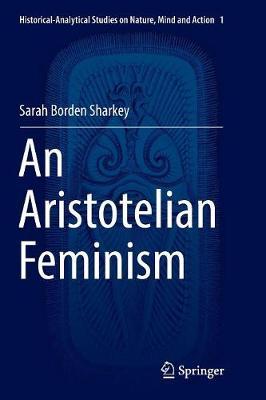
OverviewThis book articulates the theoretical outlines of a feminism developed from Aristotle’s metaphysics, making a new contribution to feminist theory. Readers will discover why Aristotle was not a feminist and how he might have become one, through an investigation of Aristotle and Aristotelian tradition. The author shows how Aristotle’s metaphysics can be used to articulate a particularly subtle and theoretically powerful understanding of gender that may offer a highly useful tool for distinctively feminist arguments. This work builds on Martha Nussbaum’s ‘capabilities approach’ in a more explicitly and thoroughly hylomorphist way. The author shows how Aristotle’s hylomorphic model, developed to run between the extremes of Platonic dualism and Democritean atomism, can similarly be used today to articulate a view of gender that takes bodily differences seriously without reducing gender to biological determinations. Although written for theorists, this scholarly yet accessiblebook can be used to address more practical issues and the final chapter explores women in universities as one example. This book will appeal to both feminists with limited familiarity with Aristotle’s philosophy, and scholars of Aristotle with limited familiarity with feminism. Full Product DetailsAuthor: Sarah Borden SharkeyPublisher: Springer International Publishing AG Imprint: Springer International Publishing AG Edition: Softcover reprint of the original 1st ed. 2016 Volume: 1 Dimensions: Width: 15.50cm , Height: 1.00cm , Length: 23.50cm Weight: 2.876kg ISBN: 9783319806693ISBN 10: 3319806696 Pages: 167 Publication Date: 22 April 2018 Audience: Professional and scholarly , Professional & Vocational Format: Paperback Publisher's Status: Active Availability: Manufactured on demand We will order this item for you from a manufactured on demand supplier. Table of ContentsChapter 1: Nussbaum, Capabilities, and Biology.- Chapter 2: An Aristotelian Account of Sex & Gender.- Chapter 3: Possibilities beyond the Bare-Bones.- Chapter 4: Why Aristotle was not a Feminist.- Chapter 5: How Aristotle might have become a Feminist.- Chapter 6: Women and the Universities.ReviewsAuthor InformationDr. Sarah Borden Sharkey, Professor of Philosophy, Wheaton College, earned her Ph.D. from Fordham University. Her interests focus on the relevance of classical and medieval ideas for contemporary discussions. She has written extensively on Edith Stein, including Edith Stein, in the series Outstanding Christian Thinkers (Continuum, 2003) and Thine Own Self: Individuality in Edith Stein’s Later Writings (Catholic University of America Press, 2009), as well as a co-edited volume on Stein’s writings on Teresa of Avila (Institute of Carmelite Studies Publications, 2015). Tab Content 6Author Website:Countries AvailableAll regions |
||||