Overview
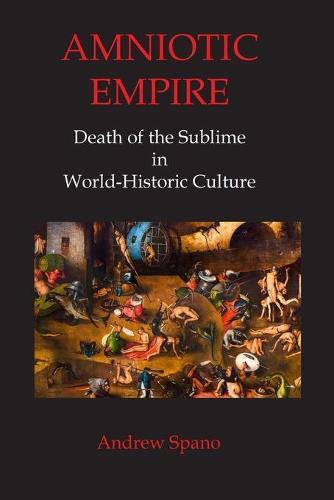
What Edmund Burke identifies as the sublime in human experience, the arts, and science has been ""overthrown"" by a new cult-like religion of Scientism. As a secular religion, this new cult structures itself on the old framework of the Christian religion, in particularly Roman Catholicism, which it attempts to displace. While it does indeed depend upon the discoveries and advances of science to evangelize its message, it relies chiefly on belief, manipulation, and coercion as much as did its predecessor, but with entertainment and consumerism rather than great art and holy ritual as its expression. It is supported by a lesser cult: The Cult of Mediocrity, represented by the creators of entertainment content, the education system, government, and the financial industry. Its basis is largely commercial, as its finance needs are infinite. However, to create the right environment for its infinite expansion, it must work closely with government and the banking system in various effective ways to achieve its end: which is the creation of the Apex Consumer, the super-consumer helplessly indebted while equally helplessly addicted to the mediocre and toxic distractions the amnion offers in place of the Sublime. The collective result is the ""amnion,"" matrix, or technosphere. It is a de facto false world that strives to be ""more real"" than reality to the consumer. Consequently, the mass of consumers have already begun to eschew the ""real"" world of cause and effect, human relations and action, and nature and the sublime. Instead, they have elected to adopt the amnion's doctrine that everything good comes ""in the future"" - including medical immortality -- if they can only keep up with the monthly payments on the debt they have taken on, fatally, through the instrument of the promissory note. The exegesis of this work relies on what it defines as the ""world-historic"" culture of the collective voices of those who valued the sublime above all else. These voices include the literary work of European and American Romantic authors, French and German philosophers, artists, scientists, mathematicians, logicians, and, to a significant degree, the philosophical and semiotic work of American philosopher, logician, mathematician, and scientist Charles S. Peirce.
Full Product Details
Author: Andrew John Spano
Publisher: Atropos Press
Imprint: Atropos Press
Edition: 3rd Revised ed.
Dimensions:
Width: 15.20cm
, Height: 2.20cm
, Length: 22.90cm
Weight: 0.576kg
ISBN: 9781940813516
ISBN 10: 1940813514
Pages: 432
Publication Date: 22 November 2021
Audience:
General/trade
,
General
Format: Paperback
Publisher's Status: Active
Availability: Available To Order

We have confirmation that this item is in stock with the supplier. It will be ordered in for you and dispatched immediately.
Reviews
Andrew Spano takes us on a thrilling, riveting and very timely journey through our contemporary world. Like Neo in the Wachowskis' film 'The Matrix' he has gradually awakened to a sense that something is fundamentally wrong with it: it appeared to him as a bubble-he aptly names it the 'amnion', or (digital) womb-in which humans craving immortality and readily submitting to a coercive consensus forged by the twin cults of Capitalism and Scientism trade sovereignty for comfort and convenience. His exploration of the 'amnion' is compelling if not exactly new-cf. e.g. Peter Sloterdijk's 'Spheres'-and wide-ranging-perhaps too much so: he takes us on a fast-paced grand tour de force that hardly leaves any milestone of western thought unturned, leaving the passenger on his train of thought at times intrigued and chuckling, at times dazzled and exhausted. Spano endeavours not to make the book overly academic; in practice this means that his narrative style is informal and he forfeits footnotes or endnotes, largely eschews citation and keeps the bibliography surprisingly short, even though he evidently strolls along a myriad of (well-trodden) paths and makes more or less overt references to a vast reservoir of thinkers and ideas. This stylistic choice leaves ample room for his own-frequently compelling-reflections and interpretations of the concepts and theories he taps into, though occasionally one wished for a footnote illuminating his references or clarifying a fleeting thought. The interior design lets the book down a little: I found the relatively large font and narrow line spacing awkward; the index is sketchy and does not correspond to the pagination-this and a few other small things evaded the editor's scrutiny.
Author Information
Andrew Spano is Ferdinand de Saussure Fellow at European Graduate School. Until 2020 he was Foreign Expert at Liaoning University in Shenyang, China; Assistant Professor and Academic Director at New York University; and Lecturer at Northeastern University for twenty years. His books include Abdication of the Sovereign Self: The Psycholinguistics of Invalid Synthetic Propositions (Cambridge Scholars); Abduction Topology: The Psycholinguistics of Discourse (Atropos); and HARDSCAPE/ABC (poetry, Atropos). He has a Ph.D. in philosophy from the European Graduate School, a master's degree in literature from the University of Vermont, and an undergraduate degree from Norwich University.