Overview
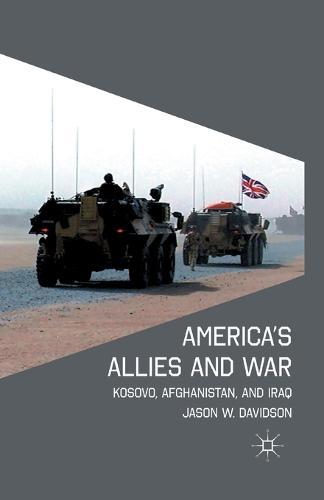
Why do Britain, France, and Italy provide or refuse military support for U.S.-led uses of force? This book provides a unique, multiple-case study analysis of transatlantic burden-sharing. Sixty original interviews with top policymakers and analysts provide insight into allies' decisions regarding the Kosovo War, Afghanistan, and the Iraq War.
Full Product Details
Author: J. Davidson
Publisher: Palgrave Macmillan
Imprint: Palgrave Macmillan
Edition: 1st ed. 2011
Weight: 0.339kg
ISBN: 9781349378548
ISBN 10: 1349378542
Pages: 250
Publication Date: 24 March 2011
Audience:
Professional and scholarly
,
Professional & Vocational
Format: Paperback
Publisher's Status: Active
Availability: Manufactured on demand

We will order this item for you from a manufactured on demand supplier.
Reviews
Jason W. Davidson's exceptional book is a must read for scholars and policy makers interested in knowing why states put troops in harm's way for the benefit of their allies. Davidson's masterful explanation of burden sharing is essential knowledge for students of history and politics, as well as decision makers crafting strategy for the future. - Patricia A. Weitsman, Professor of Political Science, Ohio University Much has been made about America's departure from its multilateralist past in recent years, but few have asked the question of why U.S. allies contribute to American military actions. Who are the willing in the 'coalitions of the willing?' And what do they gain from such contributions? Jason W. Davidson offers the most comprehensive account of this aspect of alliance politics so far, constructing a novel argument that blends elements of both international power and domestic needs. This is an important book for students and supporters of the transatlantic partnership. - Brian Rathbun, Assistant Professor of International Relations, University of Southern California Davidson's in-depth study, based on a large number of interviews with officials and opinion-makers, displays a profound understanding of the complex domestic forces and perceptions shaping foreign policy options. The analysis thus integrates first hand research materials and theoretical tools in assessing foreign policy.A careful screening of empirical results and the author's genuine curiosity of foreign political cultures makes for a rare combination. - Roberto Menotti, Senior Research Fellow, Aspen Institute Italia 'Focusing on Britain, France, and Italy in seven case studies, Davidson notes that they contributed a fair amount in Lebanon, the Persian Gulf War, Somalia, Kosovo, and Afghanistan. They refrained, to be sure, in the case of Vietnam, and only Britain contributed in the Second Gulf War. Davidson uses three variables to explain this. If the 'alliance value' is high, if 'prestige' or 'threat' to national interest is high, and if public opinion is supportive or irrelevant, allies will contribute to US-led efforts.' - Choice
Jason W. Davidson's exceptional book is a must read for scholars and policy makers interested in knowing why states put troops in harm's way for the benefit of their allies. Davidson's masterful explanation of burden sharing is essential knowledge for students of history and politics, as well as decision makers crafting strategy for the future. - Patricia A. Weitsman, Professor of Political Science, Ohio University Much has been made about America's departure from its multilateralist past in recent years, but few have asked the question of why U.S. allies contribute to American military actions. Who are the willing in the 'coalitions of the willing?' And what do they gain from such contributions? Jason W. Davidson offers the most comprehensive account of this aspect of alliance politics so far, constructing a novel argument that blends elements of both international power and domestic needs. This is an important book for students and supporters of the transatlantic partnership. - Brian Rathbun, Assistant Professor of International Relations, University of Southern California Davidson's in-depth study, based on a large number of interviews with officials and opinion-makers, displays a profound understanding of the complex domestic forces and perceptions shaping foreign policy options. The analysis thus integrates first hand research materials and theoretical tools in assessing foreign policy.A careful screening of empirical results and the author's genuine curiosity of foreign political cultures makes for a rare combination. - Roberto Menotti, Senior Research Fellow, Aspen Institute Italia 'Focusing on Britain, France, and Italy in seven case studies, Davidson notes that they contributed a fair amount in Lebanon, the Persian Gulf War, Somalia, Kosovo, and Afghanistan. They refrained, to be sure, in the case of Vietnam, and only Britain contributed in the Second Gulf War. Davidson uses three variables to explain this. If the 'alliance value' is high, if 'prestige' or 'threat' to national interest is high, and if public opinion is supportive or irrelevant, allies will contribute to US-led efforts.' - Choice
Author Information
JASON W.DAVIDSON Associate Professor of Political Science at the University of Mary Washington, Virginia, USA.