Overview
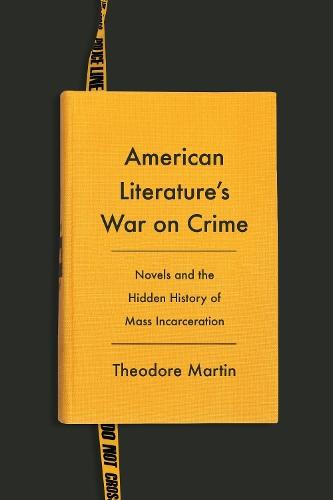
While the United States was building the world's largest prison system, Americans were reading crime novels. What did it mean to read crime fiction in a ""tough-on-crime"" era? How were fictional stories about crime linked to cultural narratives about criminality, class, and race? What did novels have to do with the making of mass imprisonment in America? Theodore Martin offers a groundbreaking account of the ways that reading habits and crime politics intersected in the age of mass incarceration. He shows how the War on Crime was waged on the page, arguing that fiction made the policies and ideologies of crime control legible to diverse readerships. American Literature's War on Crime analyzes dozens of novels-from best-sellers and prize winners to cult classics and forgotten mass-market paperbacks-by authors including Mary Higgins Clark, James Ellroy, Ralph Ellison, Donald Goines, Sue Grafton, Patricia Highsmith, Chester Himes, Stephen King, Walter Mosley, and Sister Souljah. Rewriting the history of one of the past century's most popular genres, this ambitious book reveals how the rise of mass incarceration transformed American crime fiction-and how crime fiction became a key battleground in the War on Crime.
Full Product Details
Author: Theodore Martin
Publisher: Columbia University Press
Imprint: Columbia University Press
ISBN: 9780231211802
ISBN 10: 0231211805
Pages: 304
Publication Date: 10 March 2026
Audience:
Professional and scholarly
,
College/higher education
,
Professional & Vocational
,
Postgraduate, Research & Scholarly
Format: Hardback
Publisher's Status: Forthcoming
Availability: Awaiting stock

Reviews
Pulling together a rich and eclectic archive of texts, Theodore Martin reads across multiple genres of crime fiction to narrate a wholly original account of one of the most pivotal yet taken-for-granted episodes of the late twentieth century, the rise of American mass imprisonment. With rigorous analysis and lively prose, American Literature’s War on Crime shows in luminous detail the ways that crime fiction was shaped by and in turn shaped decades of disastrous crime policy. This first of its kind volume promises to draw audiences capacious as the scope of its own argument. A remarkable achievement. -- Travis Linnemann, author of <i>The Horror of Police</i> Theodore Martin deftly illustrates how crime fiction helped inaugurate and maintain mass incarceration in the postwar decades. With breathtaking scope, American Literature's War on Crime argues convincingly that detective novels, vigilante narratives, and serial killer stories were instrumental to changes in policing and public policy. A remarkable book. -- Justin Gifford, author of <i>Revolution or Death: The Story of Eldridge Cleaver</i>
Theodore Martin deftly illustrates how crime fiction helped inaugurate and maintain mass incarceration in the postwar decades. With breathtaking scope, American Literature's War on Crime argues convincingly that detective novels, vigilante narratives, and serial killer stories were instrumental to changes in policing and public policy. A remarkable book. -- Justin Gifford, author of <i>Revolution or Death: The Story of Eldridge Cleaver</i> Pulling together a rich and eclectic archive of texts, Theodore Martin reads across multiple genres of crime fiction to narrate a wholly original account of one of the most pivotal yet taken-for-granted episodes of the late twentieth century: the rise of American mass imprisonment. With rigorous analysis and lively prose, American Literature’s War on Crime shows in luminous detail the ways that crime fiction was shaped by and in turn shaped decades of disastrous crime policy. This first of its kind volume promises to draw audiences capacious as the scope of its own argument. An astonishing achievement. -- Travis Linnemann, author of <i>The Horror of Police</i> A remarkable, in-depth study of the relationship between social unrest and the logic of literary works, American Literature’s War on Crime investigates crime fiction as a site of unrelenting debate about carceral politics and racism in the criminal justice system. Martin’s impressive book flouts distinctions between prestige and pulp to show how literature helps us make sense of why we repeatedly choose mass incarceration as the solution to the “War on Crime.” -- Michelle Robinson, author of <i>Dreams for Dead Bodies: Blackness, Labor and the Corpus of Detective Fiction</i>
Author Information
Theodore Martin is associate professor of English at the University of California, Irvine. He is the author of Contemporary Drift: Genre, Historicism, and the Problem of the Present (Columbia, 2017).