Overview
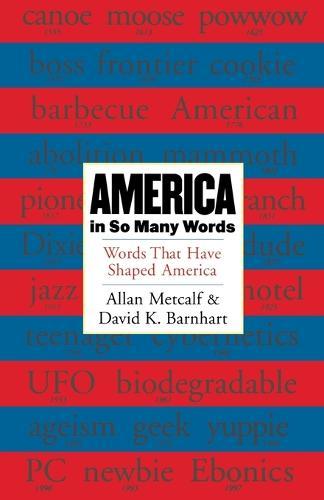
This book presents a unique historical view of American English.It chronicles year by year the contributions Americans have made to the vocabulary of English and the words Americans have embraced through the evolution of the nation.For important years from the settlement of Jamestown until 1750, and for every year from 1750 through 1998, a prominent word is analyzed and discussed in its historical context.The result is a fascinating survey of American linguistic culture through past centuries.The authors -- both lifelong students of American English -- bring great depth of understanding to these key words that have made America, and American English, what they are today.
Full Product Details
Author: David K Barnhart ,
Allan A Metcalf
Publisher: Houghton Mifflin
Imprint: Houghton Mifflin (Trade)
Weight: 0.368kg
ISBN: 9780618002702
ISBN 10: 0618002707
Pages: 308
Publication Date: 13 September 1999
Audience:
General/trade
,
General
Format: Paperback
Publisher's Status: Active
Availability: Awaiting stock

The supplier is currently out of stock of this item. It will be ordered for you and placed on backorder. Once it does come back in stock, we will ship it out for you.
Reviews
A humdinger in spades ... combining fun and solid scholarship in a rare mix. -- Evan Morris, Word Detective <br> Far excels most [books] that have been done on colorful words for the general reader. -- Jonathan Lighter, editor, The Random House Historical Dictionary fo American Slang <br> A good read, well researched, and full of interesting sidelights on the country and its language. -- Michael Quinion, World Wide Words <br>This highly selective etymological dictionary of more than 300 of the best and the brightest American words was compiled by two longtime students of American English--Barnhart, a lexicographer, and Metcalf, a college professor of English. Arrangement is chronological. The words chosen--a representative one for selected years from 1555 (canoe) to 1748 (buck), and one for each year from 1750 to 1998--are discussed in historical context, sometimes updated with contemporary quotations and with additional words similar to or connected to the key word or p
A humdinger in spades ... combining fun and solid scholarship in a rare mix. -- Evan Morris, Word Detective <br> Far excels most [books] that have been done on colorful words for the general reader. -- Jonathan Lighter, editor, The Random House Historical Dictionary fo American Slang <br> A good read, well researched, and full of interesting sidelights on the country and its language. -- Michael Quinion, World Wide Words <br>This highly selective etymological dictionary of more than 300 of the best and the brightest American words was compiled by two longtime students of American English--Barnhart, a lexicographer, and Metcalf, a college professor of English. Arrangement is chronological. The words chosen--a representative one for selected years from 1555 (canoe) to 1748 (buck), and one for each year from 1750 to 1998--are discussed in historical context, sometimes updated with contemporary quotations and with additional words similar to or connected to the key word or phrase. For example, the entry sexism and ageism (1969) mentions other -isms, and Watergate (1972) mentions other -gate terms. Black-and-white illustrations accompany some entries. The introduction has a note on sources, which include titles such as The Dictionary of American Regional English, The Random House Historical Dictionary of American Slang, and the periodical Barnhart Dictionary Companion, as well as standard English-language dictionaries. <br>The entries are organized into six chapters, from The English in America: 1497 DEGREES-1750 to Nearing the Millennium: 1945 DEGREES-1998. Words are assigned to the year in which they were newly coined or newly prominent. Entries range in length from half a page to just over a whole page. Some examples of entries from the first chapter are turkey (1607), New England (1616), public school (1636), and ice cream (1744). The concluding chapter features rock and roll (1951), fast food (1954), soccer mom (1996), Ebonics (1997), and mil
A humdinger in spades ... combining fun and solid scholarship in a rare mix. -- Evan Morris, Word Detective Far excels most [books] that have been done on colorful words for the general reader. -- Jonathan Lighter, editor, The Random House Historical Dictionary fo American Slang A good read, well researched, and full of interesting sidelights on the country and its language. -- Michael Quinion, World Wide Words This highly selective etymological dictionary of more than 300 of the best and the brightest American words was compiled by two longtime students of American English--Barnhart, a lexicographer, and Metcalf, a college professor of English. Arrangement is chronological. The words chosen--a representative one for selected years from 1555 (canoe) to 1748 (buck), and one for each year from 1750 to 1998--are discussed in historical context, sometimes updated with contemporary quotations and with additional words similar to or connected to the key word or phrase. For example, the entry sexism and ageism (1969) mentions other -isms, and Watergate (1972) mentions other -gate terms. Black-and-white illustrations accompany some entries. The introduction has a note on sources, which include titles such as The Dictionary of American Regional English, The Random House Historical Dictionary of American Slang, and the periodical Barnhart Dictionary Companion, as well as standard English-language dictionaries. The entries are organized into six chapters, from The English in America: 1497 DEGREES-1750 to Nearing the Millennium: 1945 DEGREES-1998. Words are assigned to the year in which they were newly coined or newly prominent. Entries range in length from half a page to just over a whole page. Some examples of entries from the first chapter are turkey (1607), New England (1616), public school (1636), and ice cream (1744). The concluding chapter features rock and roll (1951), fast food (1954), soccer mom (1996), Ebonics (1997), and mil
A humdinger in spades ... combining fun and solid scholarship in a rare mix. -- Evan Morris, Word Detective <br> Far excels most [books] that have been done on colorful words for the general reader. -- Jonathan Lighter, editor, The Random House Historical Dictionary fo American Slang <br> A good read, well researched, and full of interesting sidelights on the country and its language. -- Michael Quinion, World Wide Words <br>This highly selective etymological dictionary of more than 300 of the best and the brightest American words was compiled by two longtime students of American English--Barnhart, a lexicographer, and Metcalf, a college professor of English. Arrangement is chronological. The words chosen--a representative one for selected years from 1555 (canoe) to 1748 (buck), and one for each year from 1750 to 1998--are discussed in historical context, sometimes updated with contemporary quotations and with additional words similar to or connected to the key word or phrase. For example, the entry sexism and ageism (1969) mentions other -isms, and Watergate (1972) mentions other -gate terms. Black-and-white illustrations accompany some entries. The introduction has a note on sources, which include titles such as The Dictionary of American Regional English, The Random House Historical Dictionary of American Slang, and the periodical Barnhart Dictionary Companion, as well as standard English-language dictionaries. <br>The entries are organized into six chapters, from The English in America: 1497-1750 to Nearing the Millennium: 1945-1998. Words are assigned to the year in which they were newly coined or newly prominent. Entries range in length from half a page to just over awhole page. Some examples of entries from the first chapter are turkey (1607), New England (1616), public school (1636), and ice cream (1744). The concluding chapter features rock and roll (1951), fast food (1954), soccer mom (1996), Ebonics (1997), and millennium bug (1998). An index by word brings together all keywords and words discussed in the text, and an index by date lists each year from 1555 and its keyword. <br>Most of the words and phrases found here also appear in other dictionaries of American English, but this book puts a new spin on their definitions. It should appeal to both browsers and reference personnel in high-school, public, and academic libraries. It supplements more scholarly works, such as those listed in the source notes in the introduction. Copyright(c) 1998, American Library Association. All rights reserved
Author Information
Allan Metcalf is a professor of English at MacMurray College, executive secretary of the American Dialect Society, and author of books on language and writing. His books on language include AMERICA IN SO MANY WORDS (with David K. Barnhart), THE WORLD IN SO MANY WORDS, HOW WE TALK: AMERICAN REGIONAL ENGLISH TODAY, PREDICTING NEW WORDS, and PRESIDENTIAL VOICES. His books on writing include RESEARCH TO THE POINT and ESSENTIALS OF WRITING TO THE POINT. He lives in Jacksonville, Illinois.