Overview
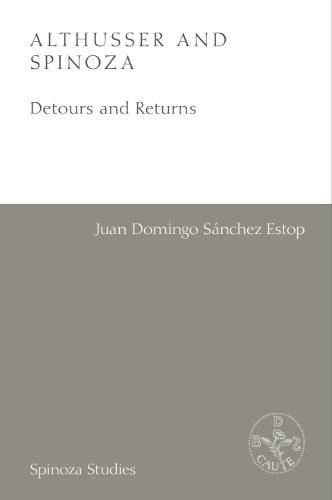
Juan Domingo Snchez Estop argues that Spinoza's influence fundamentally shaped Althusser's philosophical project, providing key concepts and methods that Althusser used to radically rethink Marxism. The book traces five key 'detours and returns' between Althusser and Spinoza, showing how Spinoza's anti-humanism, theory of reading, immanent causality, politics of the conjuncture, and rejection of determinism were mobilised at critical junctures in Althusser's development. In the process, Estop uncovers a new 'Althusserian Spinoza', a thinker of practice and politics whose revolutionary potential remains to be explored. Bringing together published works, correspondences, and unpublished writings, this groundbreaking study sheds new light on Althusser's theoretical trajectory and reveals the hidden Spinozist foundations of one of the 20th century's most important Marxist thinkers.
Full Product Details
Author: Juan Domingo Sánchez Estop (Research Fellow at the Centre de recherche en philosophie, Free University of Brussels, Belgium.) ,
Dan Taylor (Lecturer in Social and Political Thought, The Open University) ,
Élise Hendrick
Publisher: Edinburgh University Press
Imprint: Edinburgh University Press
ISBN: 9781399539890
ISBN 10: 1399539892
Pages: 296
Publication Date: 30 November 2025
Audience:
College/higher education
,
Postgraduate, Research & Scholarly
Format: Hardback
Publisher's Status: Active
Availability: Not yet available

This item is yet to be released. You can pre-order this item and we will dispatch it to you upon its release.
Reviews
Althusser and Spinoza: Detours and returns makes us see not a pre-existing object (be it Althusser or Spinoza) which we could have seen but we didn't, but an object which the book itself produced in its operation of knowledge and which did not pre-exist it. This is Sánchez Estop's synchronic/immanent object: a kaleidoscopic Althusser-Spinoza consisting of ""the anti-humanist,"" ""the reader,"" ""the structuralist,"" ""the conjuncturist,"" and ""the aleatory.""--Kiarina Kordela, Macalester College
Author Information
Juan Domingo Sánchez Estop is an associated researcher of the Cercle de Philosophie of the Université Libre de Bruxelles (ULB). A former student of Universidad Complutense de Madrid, then Professor of Philosophy at the same University, Juan Domingo Sánchez Estop has worked and published on Althusser, Spinoza, Marxism and Materialist Philosophy. He is the author of La dominación liberal (2009), under the pseudo “John Brown”; Althusser et Spinoza, détours et retours (2022); and of a Spanish translation of Spinoza’s Correspondence, Spinoza, Correspondencia completa, (1986) and the Political Treatise (forthcoming). He contributed chapters to Althusser and Law (2013) and Spinoza’s Authority (2017), along with numerous articles on Spinoza, Althusser, early modern philosophy and philosophical materialism. He is a member of the Editorial Board of the reviews Demarcaciones and Décalages, both devoted to Althusserian studies and of the Mexican review Círculo spinoziano. He is also a member of the Directive Board of the Seminario Spinoza de España. Dan Taylor is a Senior Lecturer in Social and Political Thought at the Open University. He specialises in political theory and British politics. He’s the author of three books including Spinoza and the Politics of Freedom (Edinburgh University Press, 2021), and Island Story: Journeys Through Unfamiliar Britain (shortlisted for the Orwell Prize in 2017). In 2023 he was awarded the title BBC/AHRC New Generation Thinker. Élise Hendrick is a freelance translator with twenty working languages. Most recently, she completed the first full-length English translation of the overlooked 1909 book The Social Basis of the Female Question by Aleksandra Kollontai. In addition to her work as a translator, she writes political commentary, analysis, and satire. Her writings have appeared in English, Spanish and German.