Overview
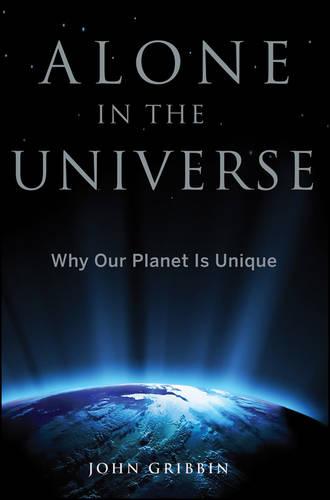
The acclaimed author of In Search of Schrodinger's Cat searches for life on other planets Are we alone in the universe? Surely amidst the immensity of the cosmos there must be other intelligent life out there. Don't be so sure, says John Gribbin, one of today's best popular science writers. In this fascinating and intriguing new book, Gribbin argues that the very existence of intelligent life anywhere in the cosmos is, from an astrophysicist's point of view, a miracle. So why is there life on Earth and (seemingly) nowhere else? What happened to make this planet special? Taking us back some 600 million years, Gribbin lets you experience the series of unique cosmic events that were responsible for our unique form of life within the Milky Way Galaxy. Written by one of our foremost popular science writers, author of the bestselling In Search of Schrodinger's Cat Offers a bold answer to the eternal question, ""Are we alone in the universe?"" Explores how the impact of a ""supercomet"" with Venus 600 million years ago created our moon, and along with it, the perfect conditions for life on Earth From one of our most talented science writers, this book is a daring, fascinating exploration into the dawning of the universe, cosmic collisions and their consequences, and the uniqueness of life on Earth.
Full Product Details
Author: John Gribbin
Publisher: Turner Publishing Company
Imprint: John Wiley & Sons Inc
Dimensions:
Width: 16.70cm
, Height: 2.20cm
, Length: 24.20cm
Weight: 0.435kg
ISBN: 9781118147979
ISBN 10: 1118147979
Pages: 240
Publication Date: 01 December 2011
Audience:
General/trade
,
General
Format: Hardback
Publisher's Status: Active
Availability: Awaiting stock

The supplier is currently out of stock of this item. It will be ordered for you and placed on backorder. Once it does come back in stock, we will ship it out for you.
Reviews
The Milky Way contains a few hundred billion stars, but almost certainly contains only one intelligent civilization, says astrophysicist and veteran popular science writer Gribbin (The Theory of Everything). In an infinite universe, on the other hand, anything is possible, but we can only explore such questions closer to home. Gribbin makes a thoroughly lucid and convincing case. Recent astronomical observations have shown that exoplanets-worlds orbiting other stars-are more common than we expected, but Earth-like worlds are rare. And even planets in a habitable zone of both a galaxy and an individual star need water and the right organic compounds to engender and sustain carbon-based life. Life got a grip on Earth with almost indecent haste, but it took Earth's metallic core and a near-twin Moon to stabilize Earth's tilt and steer off dangerous radiation; equally advantageous to Earth, Jupiter's mass pulls in most of the comets and asteroids that might otherwise smash into us. Gribbin lays out the details one by one, building a concise case that [w]e are alone, and we had better get used to the idea. (Dec.) (Publishers Weekly, October 24, 2011)
Author Information
JOHN GRIBBIN is one of today's greatest writers of popular science and the author of bestselling books including In Search of the Multiverse (Wiley), In Search of Schrodinger's Cat , and Science: A History . He trained as an astrophysicist at Cambridge University and is now Visiting Fellow in Astronomy at the University of Sussex.